 info@triniteconsulting.com
 +1 (224) 385 9760
By July, annual business plans have met operational reality. Sales forecasts may have changed, new projects may have entered the pipeline, deadlines may have shifted, and some teams may already be working at or beyond their sustainable capacity.
July is therefore an important point for businesses to review whether they have the workforce required to deliver their remaining annual goals. Effective workforce planning involves more than counting employees. Organizations must determine whether they have sufficient productive capacity, critical skill coverage and operational flexibility to meet expected demand without affecting productivity, service quality or employee well-being.
What Is Workforce Capacity Planning?
Workforce capacity planning is the process of comparing the volume of work a business expects with the people, productive hours and skills available to complete it.
It helps businesses determine whether their current staffing structure can support forecast demand or whether additional hiring, redeployment, outsourcing or temporary support will be required.
Traditional headcount planning may tell a company that it has 100 employees. Capacity planning goes further by determining how much productive work those employees can realistically deliver after accounting for:
- Leave and holidays
- Training and administrative responsibilities
- Existing project commitments
- Employee turnover and open positions
- Differences in experience and productivity
- Skill availability
- Seasonal demand
- Technology and process efficiency
A simplified capacity calculation could be expressed as:
Net available hours = Total scheduled working hours – leave, training, administrative responsibilities and existing commitments
Effective productive hours = Net available hours × expected utilization rate
The result should then be compared with the labor hours required to meet the business forecast, while skill availability and expected output should be assessed alongside it.
This distinction matters because headcount does not automatically equal capacity. A team may appear adequately staffed while lacking the specialized knowledge needed for a major project. Another team may have the right capabilities but too little available time because key employees are already assigned to other priorities.
Workforce constraints may also be connected to inefficient processes, limited technology or an operating model that no longer matches business demand. Trinite Consulting helps organizations assess these interconnected challenges and determine the right combination of business consulting, staffing, BPO and technology support.
Why Workforce Capacity Matters in the Second Half
Skills shortages remain a significant challenge for organizations across multiple industries. Employers are not only competing to attract qualified professionals but are also finding it increasingly difficult to secure the specialized skills required to support operations, technology adoption and business growth.
The OECD reports pronounced shortages across many countries in medical and personal care professions, education and ICT roles, as well as service occupations such as hospitality and tourism. Technological advancement, digitalization, demographic shifts and the transition to lower-carbon operations are further reshaping the skills organizations need.
Research on skill gaps within firms has found that shortages can increase workloads for existing employees, raise operating costs and make it more difficult to introduce new working practices. These consequences can directly affect an organization’s ability to achieve its revenue, customer service and transformation goals.
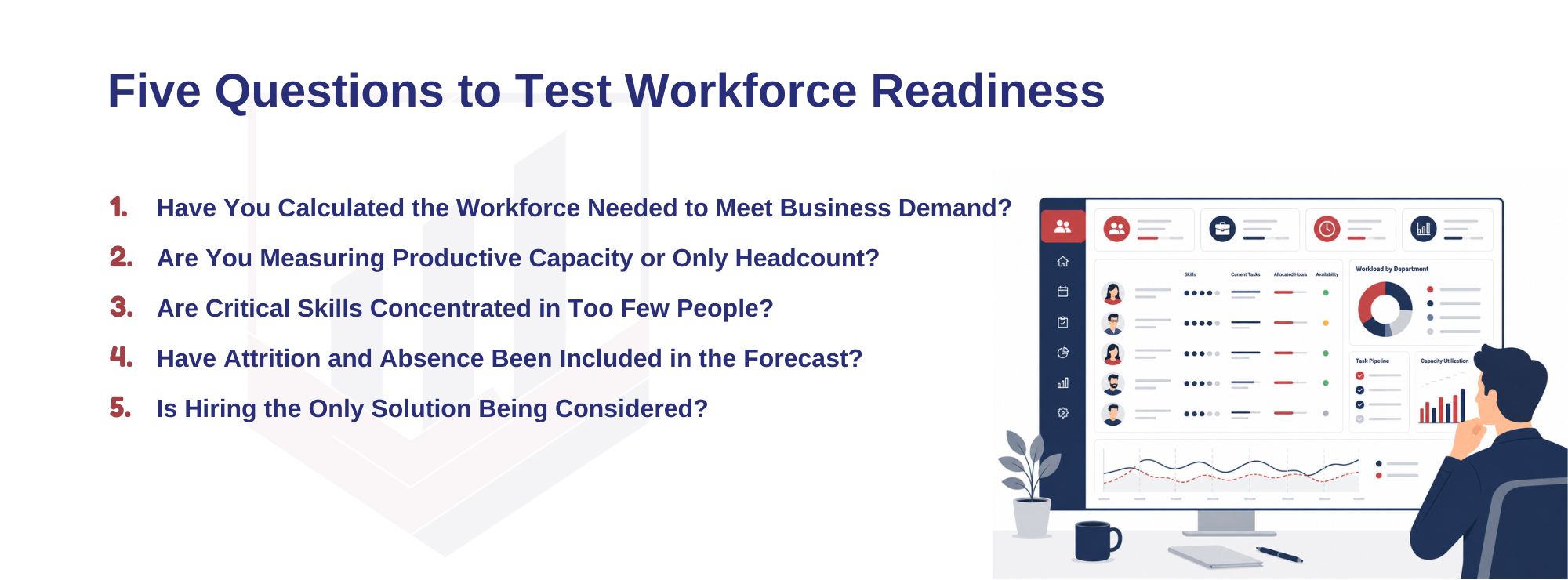
Five Questions to Test Workforce Readiness
1. Have You Calculated the Workforce Needed to Meet Business Demand?
Revenue targets alone are not enough for capacity planning. Leaders must translate business goals into the actual work required.
For example, a target to increase sales by 15% may require additional sales activity, customer onboarding, account management, technical support, billing and administrative capacity. Similarly, a new product launch may create requirements across marketing, technology, compliance, operations and customer service.
Each major business goal should be converted into measurable demand, such as:
- Projects to be delivered
- Customer requests to be handled
- Transactions to be processed
- Sales opportunities to be managed
- Technical hours required
- Service-level commitments
- Specialized roles or certifications needed
Without this conversion, management may approve ambitious business targets without recognizing the workforce demand created by them.
2. Are You Measuring Productive Capacity or Only Headcount?
Workforce capacity should reflect output, not simply the number of employees.
BLS data illustrate why productivity belongs in the calculation. U.S. nonfarm business labor productivity increased 2.8% from the first quarter of 2025 to the first quarter of 2026. During the same period, output increased 3.2%, while hours worked increased only 0.4%. These figures show that output can increase without an equivalent increase in hours worked, reinforcing the need to include productivity assumptions in workforce capacity planning. Organizations should therefore track measures such as:
- Productive hours per employee
- Output or revenue per full-time equivalent
- Billable utilization
- Overtime levels
- Backlog volume
- Absence rates
- Project completion rates
- Forecast accuracy
Persistent overtime, growing backlogs and missed deadlines are often early signs that available capacity is below demand.
3. Are Critical Skills Concentrated in Too Few People?
A company may have sufficient overall capacity while remaining highly exposed in specific roles.
Review which employees, qualifications and technical skills are essential to major projects or customer relationships. If one person’s absence, resignation or reassignment could delay delivery, the organization has a capacity risk even when total headcount appears adequate.
McKinsey recommends linking workforce planning directly to business strategy by identifying critical roles and forecasting where future gaps may emerge. This allows businesses to upskill, redeploy or hire employees before shortages affect performance.
Useful indicators include skill coverage, succession readiness, cross-training levels and the number of employees capable of performing each critical responsibility.
4. Have Attrition and Absence Been Included in the Forecast?
A capacity plan based on perfect attendance and zero employee turnover is unlikely to remain accurate.
Businesses should model at least three scenarios:
- Expected case: Demand and employee availability remain close to forecast.
- High-demand case: Sales, project volume or customer demand exceeds expectations.
- Workforce disruption case: Key employees leave, hiring is delayed or absence increases.
A U.S. Government Accountability Office review shows how unresolved workforce shortages can affect organizational performance. At the end of fiscal year 2023, the Department of Energy’s Office of Environmental Management had 263 vacant positions, an 18% vacancy rate across 14 mission-critical job categories, and 44% of its workforce was expected to be eligible for retirement by 2030.
The GAO reported that workforce-management challenges had contributed to schedule delays, cost overruns, workplace accidents and project failures. It recommended that the office develop a forward-looking workforce plan to address current shortages and future staffing risks.
A May 2026 GAO follow-up found that the workforce shortages had continued to increase and that the recommendations from the 2024 review remained open as of March 2026.
5. Is Hiring the Only Solution Being Considered?
Recruitment is important, but it is not the only way to close a capacity gap. Depending on urgency, cost and skill requirements, businesses can combine:
- Internal redeployment
- Cross-training and upskilling
- Process improvement
- Automation
- Temporary or contract staffing
- Outsourcing
- Flexible scheduling
- Permanent recruitment
When an immediate or specialized talent gap cannot be addressed internally, external staffing support can give organizations access to contingent, permanent and contract-to-hire options based on their capacity and skill requirements.
Businesses should assess whether working with a staffing agency would provide the speed, flexibility or specialized expertise needed to address their workforce gaps.
Strategic workforce planning helps organizations evaluate these alternatives using data instead of automatically adding headcount. Sustainable capacity management should consider internal mobility, reskilling, outsourcing and external hiring rather than relying on repeated hire-and-reduce cycles.
Turning the Review into an Action Plan
A practical mid-year workforce capacity review should provide a clear view of business demand, available capacity, critical skills, expected shortfalls and the actions required to address them.
Start by confirming the business goals that remain for the year. Translate those goals into workloads and skill requirements, then compare them with realistic employee availability rather than contracted working hours alone. Assign an action, owner and completion date to every significant gap.
A disciplined workforce planning process helps organizations anticipate constraints before they affect delivery, service quality or growth. It should also distinguish between issues that can be addressed through internal changes and those that require external staffing or operational support.
The final plan may include targeted hiring, contractor support, employee development, workload reprioritization, process improvements or technology investments. It should be reviewed regularly, as customer demand, employee availability and project schedules can continue to change.
Workforce capacity planning is ultimately about making business goals deliverable. Organizations that understand where capacity exists, where it is constrained and how quickly it can be adjusted are better positioned to protect service quality, improve operational efficiency and achieve their second-half targets.
Get Consultation
Related Blogs
Recent Blogs
Partner with us today!


