 info@triniteconsulting.com
 +1 (224) 385 9760
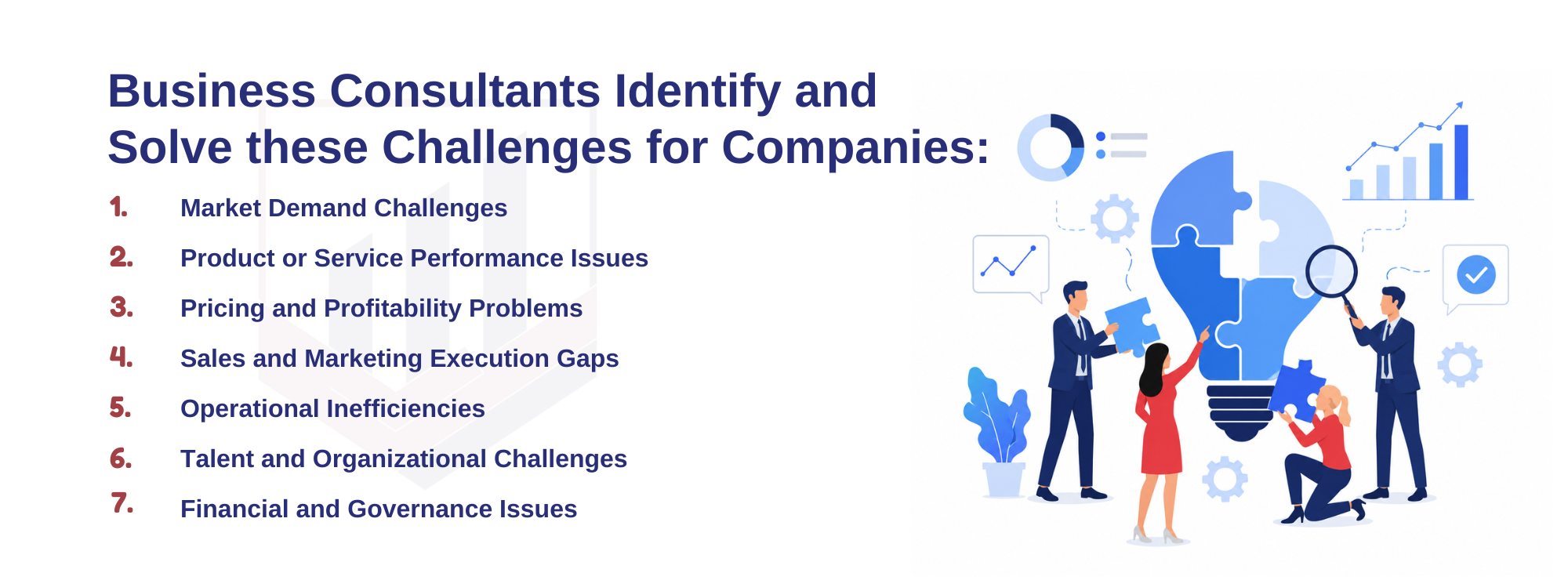
Businesses can miss growth targets for many reasons. The visible symptoms may include declining sales, missed revenue, shrinking margins, poor customer retention, or operational delays. However, the actual causes often run deeper and may involve market changes, weak sales execution, pricing issues, talent gaps, or internal inefficiencies.
A business consultant helps identify these root causes through structured analysis, data review, market assessment, and internal process evaluation. Instead of treating only the symptoms.
Business consultants help businesses identify and solve these challenges:
1. Market Demand Challenges
A decline in sales inquiries, reduced customer engagement, or competitors winning more opportunities may indicate a shift in market demand.
Common Indicators:
- Falling sales or inquiries
- Reduced market visibility
- Competitor dominance
- Weak customer engagement
Recommended Interventions:
- Re-evaluate market positioning
- Adjust target audience or service focus
- Explore new service opportunities
- Refresh branding and messaging
Consultant’s Role:
Consultants conduct market research, competitor benchmarking, and customer behavior analysis to identify demand shifts and uncover new growth opportunities.
KPIs to Track:
- Market share
- New customer acquisition
- Survey response trends
- Net Promoter Score
2. Product or Service Performance Issues
If a product or service no longer meets customer expectations, growth can slow down even when market demand exists.
Common Indicators:
- High complaint volumes
- Declining customer satisfaction
- Poor reviews
- Outdated offerings
Recommended Interventions:
- Improve product or service quality
- Upgrade delivery standards
- Remove underperforming offerings
- Introduce customer feedback loops
Consultant’s Role:
Consultants benchmark offerings against competitors, identify service gaps, and develop improvement plans aligned with customer expectations.
KPIs to Track:
- Customer satisfaction scores
- Churn rate
- Product or service performance
- Revenue by product or service line
3. Pricing and Profitability Problems
Growth targets may be missed when pricing does not match customer expectations, market value, or operational costs.
Common Indicators:
- Low profitability
- Frequent discounting
- Weak conversion rates
- Margin erosion
Recommended Interventions:
- Review pricing strategy
- Introduce bundled or tiered services
- Optimize operating costs
- Strengthen value proposition
Consultant’s Role:
Consultants assess pricing, margins, cost structures, and customer willingness to pay to improve both competitiveness and profitability.
KPIs to Track:
- Gross margin
- Win/loss ratio
- Average deal value
- Revenue by pricing tier
4. Sales and Marketing Execution Gaps
Even strong offerings can fail to grow if the sales process, lead generation strategy, or marketing execution is weak.
Common Indicators:
- Weak conversion rates
- Long sales cycles
- Poor lead quality
- Inconsistent pipeline
Recommended Interventions:
- Improve lead generation channels
- Strengthen CRM workflows
- Refine lead qualification
- Train or restructure sales teams
Consultant’s Role:
Consultants audit the sales funnel, identify bottlenecks, improve reporting systems, and help teams focus on higher-quality opportunities.
KPIs to Track:
- Leads per sales representative
- Conversion rate
- Average sales cycle length
- Sales velocity
5. Operational Inefficiencies
Internal inefficiencies can increase costs, delay delivery, and reduce customer satisfaction.
Common Indicators:
- Production or delivery delays
- High overhead costs
- Workflow bottlenecks
- Resource allocation issues
Recommended Interventions:
- Streamline workflows
- Standardize processes
- Invest in automation
- Outsourcing non-core activities with Business Process Outsourcing (BPO)
Consultant’s Role:
Consultants map existing processes, identify waste, and recommend process improvements, automation, or outsourcing options through BPO services to improve efficiency.
KPIs to Track:
- Cycle time
- Process error rate
- Cost per unit or service
- Productivity metrics
6. Talent and Organizational Challenges
Skill gaps, hiring delays, and employee turnover can directly affect growth, delivery quality, and customer experience.
Common Indicators:
- High attrition
- Unfilled key roles
- Lack of specialized skills
- Low employee engagement
Recommended Interventions:
- Improve recruitment strategy
- Upskill existing employees
- Strengthen retention programs
- Staffing services and support for hiring leadership
Consultant’s Role:
Consultants support workforce planning, talent audits, restructuring, and employee engagement strategies. Through staffing services, they can also help hire well-vetted, desired talent quickly, with flexible hiring models like contract hires.
KPIs to Track:
- Employee turnover rate
- Time-to-fill positions
- Engagement scores
- Productivity indicators
7. Financial and Governance Issues
Weak financial visibility and unclear accountability can prevent leaders from making timely and confident decisions.
Common Indicators:
- Budget overruns
- Cash flow concerns
- Inaccurate forecasting
- Undefined business goals
Recommended Interventions:
- Improve budgeting controls
- Strengthen financial reporting
- Set clear KPIs
- Clarify roles and accountability
Consultant’s Role:
Consultants help establish governance frameworks, forecasting systems, and performance tracking processes that support better decision-making.
KPIs to Track:
- Budget variance
- Cash runway
- Forecast accuracy
- Goal achievement percentage
Conclusion
Missing growth targets is rarely caused by one issue alone. It is usually the result of multiple factors, including market shifts, internal inefficiencies, pricing gaps, sales challenges, talent shortages, or weak financial controls.
Get Consultation
Related Blogs
Recent Blogs
Partner with us today!


