 info@triniteconsulting.com
 +1 (224) 385 9760
By the end mid-year, many organizations begin evaluating whether they are on track to meet annual growth targets. If revenue growth has slowed, operating costs are increasing, or customer retention is weakening, the mid-year period becomes a critical opportunity to reassess strategy and make operational adjustments before entering the final quarters of the year.
A successful mid-year course correction often depends on identifying operational bottlenecks, aligning business strategy with current market conditions, and strengthening workforce capabilities. Business consulting, Business Process Outsourcing (BPO), and staffing services can play a major role in helping organizations regain momentum and improve business performance.
Identifying Mid-Year Business Challenges
Leadership teams should closely monitor key performance indicators (KPIs) during mid-year to identify warning signs early. Important metrics include:
- Revenue growth rate
- Customer churn rate
- Customer acquisition cost (CAC)
- Customer lifetime value (LTV)
- Operating expenses (OPEX)
- Capacity utilization
- Employee attrition
When operating expenses rise faster than revenue or customer churn increases, profitability and long-term growth become difficult to sustain. Similarly, low capacity utilization indicates that resources are not being used efficiently.
Mid-year challenges generally fall into three categories:
Strategic Misalignment
Business priorities no longer align with market conditions or customer expectations.
Operational Bottlenecks
Inefficient workflows, siloed systems, or manual processes slow down execution.
Talent and Resource Gaps
Organizations lack the required workforce, expertise, or scalability needed for growth.
In many cases, growth stalls not because of a lack of vision, but because execution becomes difficult as operations expand.
Consulting: Strategic and Operational Realignment
Business consulting services help organizations identify performance gaps, optimize operations, and realign business strategy.
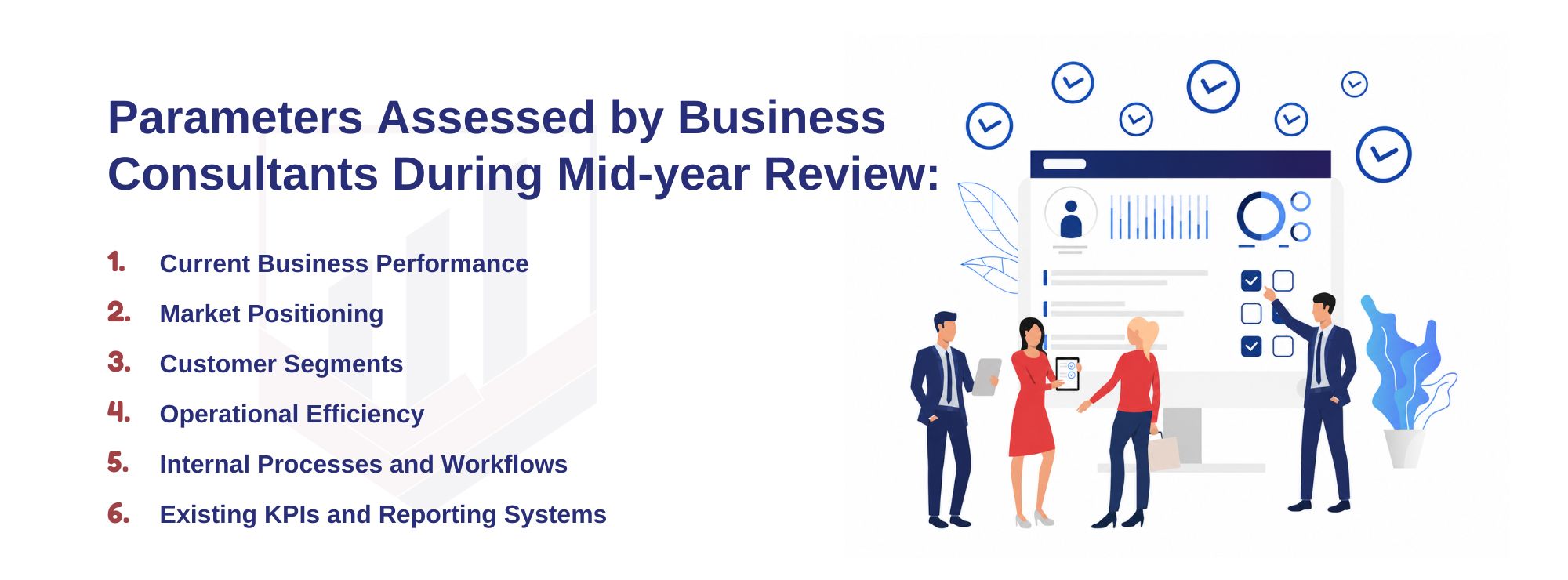
During a mid-year review, consultants typically assess:
- Current business performance
- Market positioning
- Customer segments
- Operational efficiency
- Internal processes and workflows
- Existing KPIs and reporting systems
The goal is to identify areas where the organization is losing efficiency, revenue, or competitive advantage.
Common Consulting Interventions
Consultants often support businesses through:
- Strategic planning and goal realignment
- Process optimization initiatives
- Workflow redesign
- Customer retention strategies
- Change management support
- KPI and reporting framework development
Operational consultants may use Lean or Six Sigma methodologies to streamline workflows and reduce inefficiencies. Strategic consultants may conduct SWOT analyses, market evaluations, or performance gap studies to identify growth opportunities.
Customer strategy also becomes important during a mid-year correction. Organizations may need to focus more heavily on high-value customers, retention initiatives, and service improvements instead of broad acquisition efforts.
Example Scenario
Consider a company experiencing flat revenue growth despite maintaining strong sales activity. A consulting review reveals that customer churn is increasing and operational handoffs between departments are causing delays.
The consulting team recommends:
- Strengthening customer retention programs
- Improving communication between teams
- Reallocating budgets toward high-performing customer segments
- Streamlining operational workflows
- Introducing measurable performance metrics
This type of intervention helps organizations bridge the gap between business strategy and execution.
Leveraging BPO for Scalability and Efficiency
Business Process Outsourcing (BPO) allows organizations to outsource operational functions to external service providers. Common outsourced functions include:
- Customer support
- Finance and accounting
- Payroll processing
- HR operations
- IT helpdesk services
- Back-office administration
BPO enables organizations to scale operations without significantly increasing fixed overhead costs.
Benefits of BPO
One of the primary advantages of BPO is cost optimization. Outsourcing providers often operate with specialized teams, standardized processes, and automation technologies that improve efficiency.
Key benefits include:
- Reduced operational costs
- Improved scalability
- Faster process execution
- Access to specialized expertise
- Better process standardization
- Increased operational flexibility
Organizations also benefit from Service Level Agreements (SLAs), which help maintain quality and performance standards.
Common BPO Use Cases
BPO becomes particularly valuable when internal teams are overwhelmed with routine or repetitive tasks.
Typical examples include:
- Outsourcing customer support during seasonal demand spikes
- Delegating invoice processing and collections
- Managing compliance and administrative tasks
- Supporting back-office operations during periods of growth
By shifting operational workloads to a BPO partner, internal teams can focus on strategic business priorities.
Time-to-Value
BPO implementation typically involves:
- Process assessment
- Knowledge transfer
- Team onboarding and training
- Systems integration
- Performance monitoring
Although setup may take several weeks, organizations often experience operational improvements quickly once processes are transitioned successfully.
Example Scenario
A retail company struggling with customer support delays outsources chat and email support to a BPO provider. Within a few months, response times improve significantly while support costs decline. Internal resources are then redirected toward sales and customer engagement initiatives.
Leveraging Staffing Services for Workforce Agility
Staffing services help organizations quickly scale teams by providing temporary, contract, or specialized talent.
Unlike outsourcing, staffing solutions place professionals directly within the company’s operational structure while reducing recruitment time and hiring overhead.
Benefits of Staffing Solutions
Staffing services offer several advantages:
- Faster hiring timelines
- Access to specialized talent pools
- Flexible workforce scaling
- Reduced recruitment burden
- Lower hiring risk through temp-to-hire models
Specialized staffing agencies can often fill roles significantly faster than traditional hiring methods.
Common Staffing Use Cases
Staffing support is commonly used for:
- Short-term project requirements
- Seasonal workforce expansion
- Specialized technical roles
- Interim leadership positions
- Rapid scaling during business growth
Staffing also complements consulting initiatives. If consultants identify operational skill gaps, staffing partners can quickly provide the required professionals.
Example Scenario
A technology company acquires a new product line and urgently requires additional software developers. Through a staffing partnership, qualified contract engineers are onboarded within weeks, helping the company maintain delivery timelines and support continued growth.
Sequencing the Right Solution
Not every business challenge requires consulting, BPO, and staffing simultaneously. The right approach depends on the organization’s primary bottleneck.
When to Use Consulting
Consulting should typically be the first step when:
- Strategic direction is unclear
- Business performance is stagnating
- Processes require optimization
- Teams lack alignment
- KPIs are inconsistent or ineffective
Consultants help diagnose root causes and create a structured improvement plan.
When to Use BPO
BPO is most effective when:
- Operational workloads exceed internal capacity
- Costs need to be reduced
- Processes are repetitive and time-consuming
- Scalability is required quickly
When to Use Staffing
Staffing becomes valuable when:
- There are immediate skill shortages
- Workforce capacity is insufficient
- Specialized expertise is needed temporarily
- Hiring timelines are delaying projects
In many situations, organizations combine all three solutions for maximum impact.
Measuring Success
Every mid-year intervention should be tied to measurable outcomes.
Common KPIs include:
Financial Metrics
- Revenue growth
- EBITDA improvement
- Gross margin improvement
- Cost reduction
Customer Metrics
- Customer retention
- Net Revenue Retention (NRR)
- Customer satisfaction scores
Operational Metrics
- Process cycle time
- Error reduction
- Productivity improvements
- Capacity utilization
Workforce Metrics
- Time-to-hire
- Employee productivity
- Workforce utilization
Organizations should establish regular dashboard reviews and track progress weekly or monthly.
Risks and Mitigation Strategies
Although consulting, BPO, and staffing provide major benefits, organizations must manage associated risks carefully.
Common Risks
- Lack of internal buy-in for consulting recommendations
- Overdependence on outsourcing providers
- Quality control concerns
- Cultural misalignment with external teams
- Rapid hiring resulting in poor candidate fit
- Change fatigue across internal teams
Mitigation Strategies
Organizations can reduce these risks by:
- Maintaining strong governance structures
- Starting with pilot programs
- Establishing clear SLAs and KPIs
- Using phased implementation approaches
- Conducting regular performance reviews
- Ensuring leadership alignment and communication
A structured implementation approach improves adoption and long-term success.
Recommended Mid-Year Action Plan
May
- Conduct a mid-year leadership review
- Analyze KPIs and identify major business challenges
- Prioritize operational and strategic gaps
June
- Engage consulting support if required
- Develop revised business priorities
- Evaluate potential BPO and staffing partners
July
- Launch pilot outsourcing initiatives
- Begin targeted staffing efforts
- Implement operational quick wins
August
- Fully execute revised plans
- Onboard external teams and new hires
- Monitor KPIs closely and optimize execution
Regular review meetings throughout this period help ensure the organization remains aligned with growth objectives.
Conclusion
Mid-year slowdowns do not necessarily indicate long-term failure. In many cases, they provide an opportunity to reassess operations, improve execution, and strengthen organizational agility before the final quarters of the year.
Consulting services help organizations identify strategic and operational gaps. BPO solutions improve scalability and efficiency. Staffing services provide the workforce flexibility needed to respond quickly to changing business demands.
By taking proactive action between May and August, organizations can reposition themselves for stronger performance, improved operational efficiency, and sustainable long-term growth.
Get Consultation
Related Blogs
Recent Blogs
Partner with us today!


