 info@triniteconsulting.com
 +1 (224) 385 9760
The business landscape of 2026 looks nothing like what companies planned for just three years ago. Global supply chains remain fragile. Economic uncertainty continues to mount. And perhaps most concerning, companies that lack resilience are losing revenue in ways they don't even realize.
The hard truth? Growth no longer means hiring more people. In fact, companies that still operate on the "more headcount equals more revenue" model are leaving money on the table while increasing their vulnerability to disruption.
The New Reality: Hiring Freezes Are Here to Stay
The numbers tell the story. Major tech companies including Google, Meta, Amazon, and Apple have implemented sustained hiring pauses, cutting active job postings by as much as 98% in some regions. But this isn't just a tech problem. IT services companies have seen active demand for talent drop from 80,000 positions to 55,000—a 31% decline. And according to recruitment data, hiring mandates have been slashed across industries, with talent demand dropping nearly 20% between January and March 2025 compared to the previous quarter.[1][2]
What's different now is the permanence. Unlike the temporary freezes of 2020, companies aren't treating this as a pause—they're fundamentally restructuring how they deploy people. Rather than replacing employees who leave, organizations are consolidating roles, increasing workloads for existing staff, and looking for alternatives to headcount expansion.
Meanwhile, global disruptions continue to compound the problem. Supply chain volatility, geopolitical tensions, changing regulations, and climate-related risks mean that companies can no longer rely on stable operating conditions. Enterprises with strong resilience frameworks are 2.5 times more likely to recover from crises, according to McKinsey research. The question is: how do you build that resilience when you can't hire?[3]
The Silent Profit Killer: Revenue Leakage in Existing Operations
Here's what most companies don't talk about in board meetings: they are losing money from inefficient backend operations.
If you haven't had a chance to have a business consultant go through your baseline operations, there's a good chance you're leaking revenue every single month. Not because your team isn't working hard, but because most operations were never designed to scale efficiently.
The numbers are sobering. Studies show that organizations typically lose between 1% and 5% of their annual earned revenue to operational inefficiencies, billing errors, and process failures. For a company with $250 million in annual revenue, that's $7.5 million in pure profit disappearing—money that has already been earned but never collected. Other research suggests that operational inefficiencies can drain 15% to 20% of revenue across the entire revenue cycle, including delays, manual work errors, and friction in billing, contracting, and service delivery.[4][5]
These leaks come from multiple sources: outdated pricing models, data silos between CRM and billing systems, unbilled usage and overages, missed contract renewals, and the simple reality that most backend processes still depend on manual human work. When you add a hiring freeze on top of this, your existing team becomes stretched thinner, mistakes multiply, and the leakage gets worse—not better.[6]
The irony? You already have the revenue. You just need to stop losing it.
The Strategic Solution: Business Process Outsourcing as a Resilience Engine
This is where business process outsourcing (BPO) enters the picture—not as a cost-cutting tactic, but as a strategic lever for building organizational resilience.
When companies face hiring restrictions, they have three choices: do more with the same people (a recipe for burnout), turn away business (leaving revenue on the table), or find a smarter way to manage the work. BPO is that smarter way.
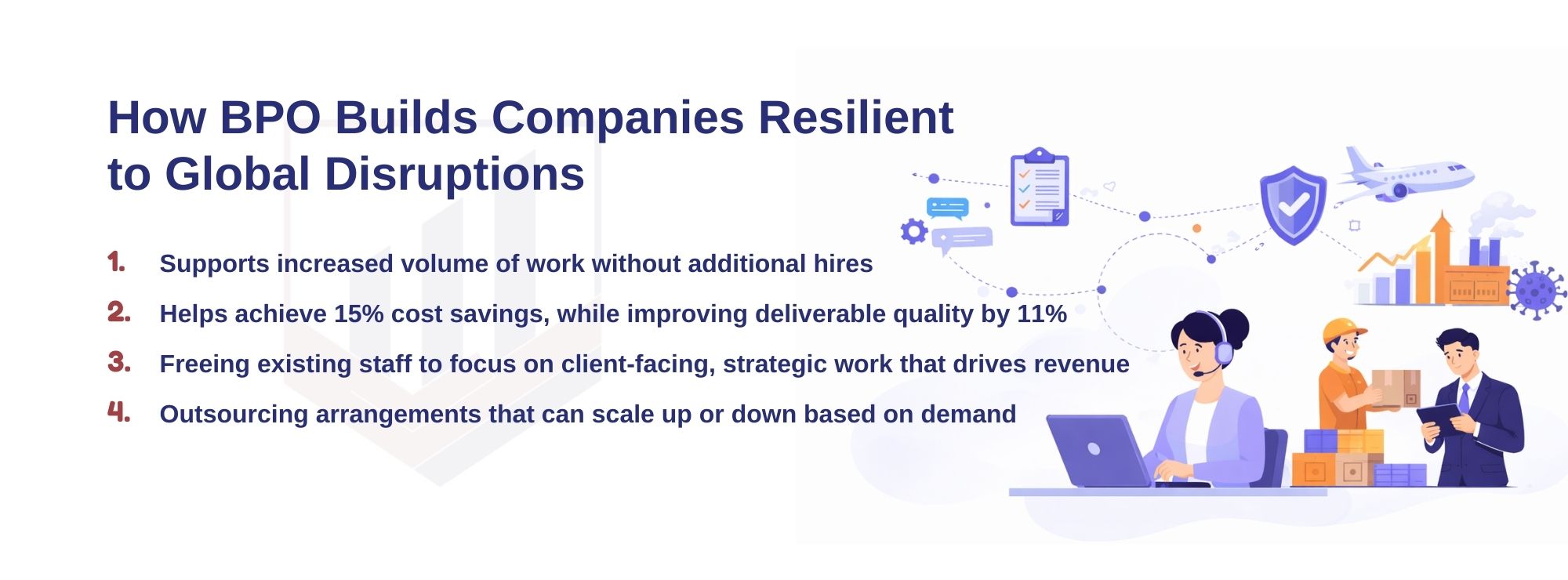
Research from Information Services Group found that enterprises achieve an average of 15% cost savings by outsourcing business processes compared to in-house operations. But the real value goes beyond cost reduction. According to the same study, organizations that outsource also improve their quality performance by an average of 11%, while simultaneously gaining the capacity to support increased volume of work. Companies can reduce labor costs by up to 70% when outsourcing to specialized providers, while simultaneously freeing existing staff to focus on what they do best: client-facing, strategic work that drives real revenue and competitive advantage.[7][8]
The flexibility advantage is equally important. BPO arrangements can scale up or down based on demand. During a downturn, you reduce outsourcing commitments without the painful process of layoffs. During growth, you scale without the lag time of hiring, onboarding, and training new employees. You maintain the operational agility to adapt quickly to changing conditions—precisely what resilience requires.
Use Business Process Outsourcing to Scale Without Adding Headcount
This is precisely the problem that Business Process Outsourcing is designed to solve. Rather than hiring more backend staff, Trinite helps you manage tighter deadlines and higher volumes of work with your existing staff count.
The operational efficiency gains are measurable: fewer manual touchpoints, faster turnaround times of up to 30%, and critically, more time for your team to spend on client-facing work. When your backend processes are optimized and outsourced, your most valuable employees aren't spending eight hours a day processing invoices or updating spreadsheets. They're selling, strategizing, and building relationships.[1]
This creates a multiplier effect on profitability. You're not just cutting costs—you're redirecting the finite hours your team has toward revenue-generating activities. A team of ten people suddenly has the operational capacity of twelve or fifteen, without the fixed cost of additional payroll, benefits, recruitment, and management overhead.
Conclusion: Building True Operational Resilience
The companies that will thrive in 2025 and beyond won't be those that return to "normal" hiring practices. They'll be those that recognize that operational resilience comes from three things:
First, they eliminate revenue leakage by bringing discipline, automation, and real-time visibility to backend operations. They audit their processes ruthlessly, identify where money is disappearing, and fix it.[5][4]
Second, they leverage outsourcing strategically—not as a temporary patch, but as a permanent part of their operating model. They treat BPO as a flexible, scalable alternative to headcount that allows them to manage disruption while maintaining quality and speed.[9][10]
Third, they design their organizations around leverage, not labor. They build systems and processes that don't depend on adding more people. They create the capacity to do more with the resources they have.[11]
When you combine these three elements, something remarkable happens. Additional ways of insulation against the current economic uncertainties include using staffing services to keep an agile workforce. You become insulated from hiring restrictions because you're not dependent on continuous or traditional hiring. You become resilient to disruption because your operations are lean and flexible. And you become more profitable because you've stopped losing revenue and started redirecting the work of your best people toward activities that actually drive growth.
References:
- https://taggd.in/hr-glossary/hiring-freeze/
- https://economictimes.com/tech/information-tech/its-hiring-plans-on-ice-as-tariff-war-sends-shivers/articleshow/120355339.cms
- https://www.rocket.chat/blog/business-resilience
- https://www.linkedin.com/pulse/ai-vs-invisible-revenue-losses-deep-dive-proactive-leakage-abufadda-ekblf
- https://optimus.tech/blog/safeguard-every-cent-a-framework-to-detect-and-prevent-revenue-leakages-in-finance-ops
- https://www.icertis.com/learn/revenue-leakage
- https://ir.isg-one.com/news-market-information/press-releases/news-details/2024/ISG-Study-Finds-Enterprises-Save-an-Average-of-15-Percent-with-Business-Process-Outsourcing/default.aspx
- https://www.bruntwork.co/bpo-advantages
- https://www.invensis.net/blog/benefits-of-bpo
- https://helpware.com/blog/advantages-business-process-outsourcing
- https://smlbizblueprint.com/scale-your-business-without-hiring
Get Consultation
Related Blogs
Recent Blogs
Partner with us today!


