 info@triniteconsulting.com
 +1 (224) 385 9760
Organizational change has become a constant across industries. Companies invest heavily in digital transformation, operating model redesigns, system implementations, and cultural initiatives—yet outcomes frequently fall short of expectations. Research consistently indicates that 60–70% of change initiatives fail to meet their objectives, resulting in lost productivity, employee disengagement, and unrealized business value.
These failures are rarely caused by flawed strategy or technology. Instead, they stem from gaps in execution, alignment, and adoption. In complex business environments such as Chicago, disciplined change management often determines whether transformation efforts succeed or stall.
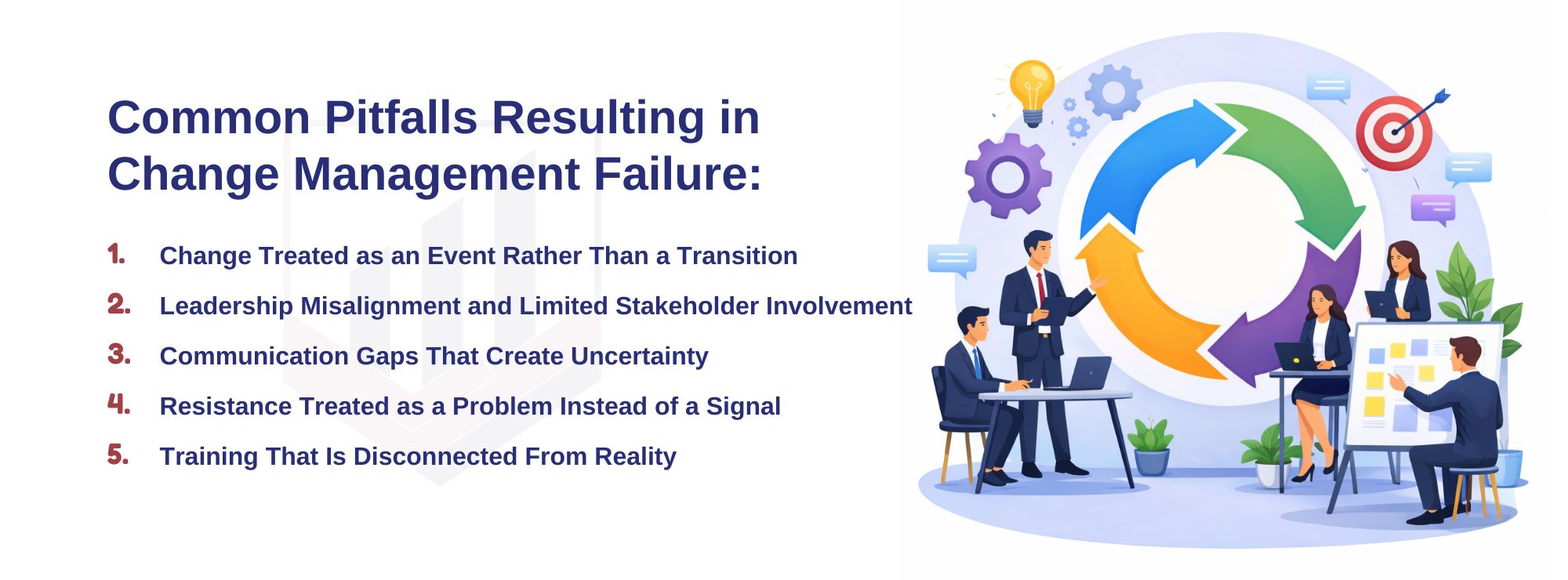
Common Pitfalls Resulting in Change Management Failure
Change Treated as an Event Rather Than a Transition
A common failure pattern is treating change as a single milestone rather than a transition that unfolds over time. Organizations frequently equate success with implementation dates—system go-lives, restructuring announcements, or policy rollouts—without addressing how behaviors must evolve afterward.
When adoption is not actively managed, employees default to familiar ways of working, gradually eroding the intended benefits of the change. Over time, this creates a gap between formal process design and actual day-to-day execution.
Effective change environments recognize change as a phased progression involving preparation, adoption, stabilization, and reinforcement—rather than a one-time rollout.
Leadership Misalignment and Passive Sponsorship
Leadership alignment is one of the strongest predictors of change success, yet it is also one of the most common points of failure. While executives may formally approve initiatives, inconsistent messaging or limited visible engagement weakens credibility across the organization.
Employees tend to mirror leadership behavior. When leaders appear divided, distracted, or disengaged, confidence in the change effort declines rapidly—especially at the middle-management and frontline levels where implementation occurs.
Sustained change requires consistent leadership behavior, shared accountability, and visible commitment beyond initial announcements.
Communication Gaps That Create Uncertainty
Poor communication continues to undermine change initiatives. Employees frequently report that they understand what is changing but not why it matters or how it affects their roles. Generic announcements, infrequent updates, and one-way messaging leave room for speculation and resistance.
More effective change efforts rely on structured communication that:
- Explains the rationale behind change
- Clarifies role-level impact
- Provides regular progress updates
- Enables two-way feedback
When communication is tailored and reinforced, uncertainty decreases and trust improves.
Resistance Treated as a Problem Instead of a Signal
Resistance to change is a natural human response, particularly in environments marked by uncertainty or prior failed initiatives. However, resistance is often misinterpreted as defiance rather than a signal of unresolved concerns.
Unmanaged resistance significantly lowers adoption rates and increases employee turnover during periods of change. Common drivers include lack of clarity, perceived loss of control, skill gaps, and fear of the unknown.
Organizations that actively surface and address resistance tend to achieve higher adoption and stability than those that attempt to push change through authority alone.
Training That Is Disconnected From Reality
Another frequent failure point is insufficient or poorly timed training. One-time workshops delivered weeks before implementation rarely prepare employees for real-world application. When training does not reflect actual job scenarios, employees struggle to apply new processes under pressure.
Effective change environments emphasize role-specific, just-in-time learning supported by coaching, reinforcement, and accessible performance aids.
Limited Stakeholder Involvement
A persistent gap often exists between leadership perception and employee experience. While leaders may believe stakeholders are involved, employees frequently report feeling excluded from decisions that directly affect their work.
When frontline insights are missing, change designs may appear logical at a strategic level but prove impractical in execution. This disconnect leads to rework, frustration, and declining engagement.
Inclusive change approaches involve stakeholders throughout the lifecycle—from early design through implementation and reinforcement—improving both solution quality and ownership.
Change Fatigue and Cultural Constraints
Repeated transformation initiatives without adequate recovery periods contribute to change fatigue, a condition increasingly reported across organizations. Employees experiencing fatigue are less likely to engage, more likely to resist, and more inclined to disengage or leave.
Cultural factors further influence outcomes. Organizations with a history of unsuccessful change often develop skepticism, where employees assume new initiatives will eventually fade.
Addressing fatigue and cultural barriers requires readiness assessment, realistic sequencing of initiatives, visible early wins, and transparent prioritization.
Relevance in Chicago’s Business Environment
Intense competition across Chicago’s major industries places added pressure on organizations to implement change quickly—often without sufficient time for adoption and stabilization. This urgency increases the risk that transformation efforts prioritize speed over sustainability.
In such conditions, change initiatives that lack structure, reinforcement, and alignment are more likely to stall after initial rollout. Organizations operating in competitive markets benefit from approaches that balance execution velocity with long-term adoption.
The Role of Business Consulting in Change Outcomes
Organizations that apply structured change management practices are significantly more likely to meet objectives, remain on schedule, and realize return on investment. Chicago-focused business consulting contributes perspective, discipline, and methodological rigor—particularly in navigating the human dynamics that internal teams may underestimate or overlook.
By integrating leadership alignment, communication, training, and adoption measurement into transformation efforts, organizations reduce risk and increase the likelihood of sustained success.
Conclusion
Change initiatives fail not because organizations lack ambition, but because execution falters at the human level. Leadership misalignment, weak communication, unmanaged resistance, and change fatigue consistently undermine even well-designed strategies.
In competitive markets like Chicago, disciplined change management separates temporary disruption from lasting improvement. When organizations approach change as a structured, people-centered process rather than a technical exercise with the help of a dedicated business consultant, transformation becomes a driver of resilience, performance, and long-term growth.
References:
- Prosci – Why Change Management Fails
- Gartner – Change Management Research and Trends
- WalkMe – Change Management Statistics and ROI
- IMD – Reasons Organizational Change Fails
Get Consultation
Related Blogs
Recent Blogs
Partner with us today!


