 info@triniteconsulting.com
 +1 (224) 385 9760
As the fiscal year hits the halfway point, leaders must determine if performance shortfalls are tactical hiccups or signs of deeper issues. This blog outlines how to diagnose warning signals in finances, operations, people, customers and strategy, distinguish symptoms from root causes, and choose the right fix — be it business consulting, BPO, or staffing. We present a decision framework for when to engage consultants versus outsourcing or hiring, plus a practical mid-year assessment checklist. Finally, we discuss quick wins versus long-term initiatives, metrics to track improvement, and next steps for working with Trinite. Our goal is to give managers a clear, step-by-step guide to course-correct effectively and regain momentum in the second half of the year.
Diagnostic Indicators: Recognizing the Warning Signs
A mid-year check should survey multiple KPI categories.
Financial KPIs:
Is revenue lagging forecasts or margins shrinking? Unexpected cost overruns, cash flow strain, or inventory buildup all signal trouble. Compare actuals to budgeted targets – for example, a product line underperforming by >10–20% may need action.
Operational KPIs:
Look for process bottlenecks (e.g. long cycle times, high error/return rates, and late deliveries) and backlog growth. Low engagement and productivity challenges can carry a significant financial cost. Gallup has estimated that disengaged and not-engaged U.S. employees account for about $1.9 trillion in lost productivity.
People KPIs:
Track turnover, overtime hours, employee engagement, and skills gaps. High turnover, sustained overtime, rising absenteeism, workload imbalance, or repeated deadline pressure may point to burnout, capacity gaps, or inefficient processes. Replacing staff can also create significant recruitment, onboarding, training, and productivity costs. Employee replacement costs vary by role and seniority, and SHRM-cited research suggests total turnover costs can range from 90% to 200% of annual salary in some cases.
Customer KPIs:
Monitor satisfaction scores, Net Promoter Score, churn rate and complaint trends. A rise in service complaints may indicate deeper operational, communication, or process-related issues, especially when delays, handoffs, or unclear documentation affect the customer experience.
Strategic KPIs:
Review progress on key initiatives and market targets. Has the pipeline dried up? Are new product launches delayed? If leadership finds itself scrambling or repeatedly missing milestones, these are red flags. A formal “Opportunity to Check In” at mid-year is recommended by experts to evaluate what’s working and refine goals in real time.
Symptoms vs. Root Causes: Digging Deeper
Before deciding on help, differentiate surface symptoms from underlying issues. Flat sales or shrinking profit margins may be symptoms of something deeper. As one business consultant notes, leaders often blame markets or sales teams for a growth plateau, when “the real cause is upstream: a strategic mismatch or operational bottleneck that no amount of sales effort will fix”. For example, stagnant revenue for several quarters may reflect a flawed pricing model or misaligned value proposition, not just a cyclical slowdown. Consultants excel at root cause analysis (using tools like process mapping or Five Whys) to find these hidden issues. Business consulting can be defined as “identifying blockers to the smooth flow of materials and information across a company’s value chain, strategizing to improve the flow and using change management to transform the process landscape”. In practice, that means asking: Are sales shortfalls due to market shifts or internal failures? Is customer churn driven by competitive forces or by service delays? A careful diagnosis prevents wasting time on quick fixes that don’t stick.
Business Consulting vs. BPO vs. Staffing: Decision Framework
| Problem/Scenario | Consulting (When Best) | BPO (When Best) | Staffing (When Best) |
|---|---|---|---|
| Strategy/Performance gap (e.g. flat growth, missed targets) | Tackling unclear strategy or competitive misalignment; requires expert diagnosis and a roadmap | Only if non-core tasks are crowding resources; not primary solution | Not ideal for core strategy issues; improves execution only |
| Process inefficiency (e.g. workflow bottlenecks, quality issues) | Reengineering workflows and systems; diagnosing unknown causes | Ideal for outsourcing repetitive back-office functions (finance, customer support, data entry) | Good for adding capacity when internal team is overwhelmed |
| Capacity/skill shortage (e.g. talent gaps, surge demand) | Unnecessary if issues are purely headcount or skills | If an entire function can be offloaded end-to-end | Best for filling roles quickly (e.g. contract hires, temp staff) |
In summary: Consulting is best when you need strategic clarity or problem diagnosis beyond your team’s expertise. Business Process Outsourcing works when well-defined, repeatable processes can be handled by an external team, freeing internal staff. Staffing services are ideal for short-term surges or specific skill gaps under your control.
Mid-Year Business Assessment Checklist
Use this step-by-step guide to conduct your review:
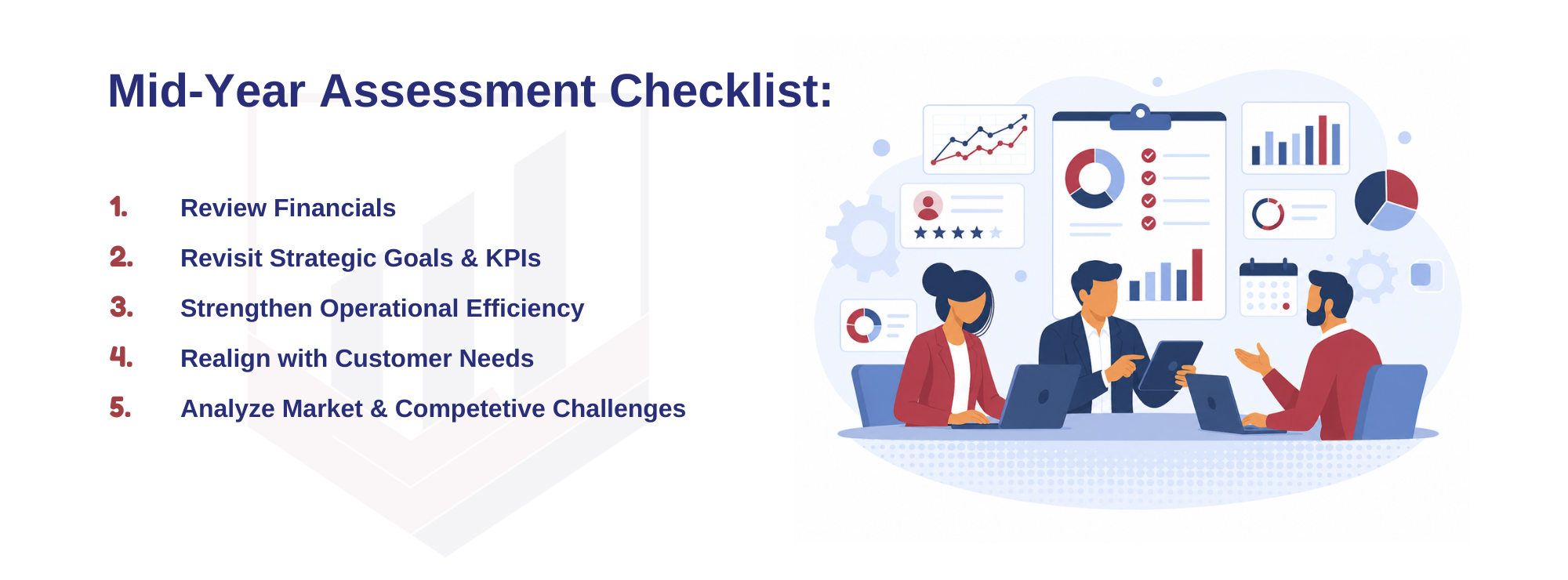
Review Financials:
Examine income statements, cash flow, and balance sheets against budget. Identify revenue shortfalls or expense overruns. Pinpoint underperforming products/services. Early detection of financial losses can help prevent larger surprises later.
Revisit Strategic Goals & KPIs:
Compare actual progress on key objectives (market expansion, product launches, etc.) and KPIs to plans. Ask: Are customer acquisition and retention targets on track? If market conditions shifted, update goals now while resources are available.
Strengthen Operational Efficiency:
Audit core processes: map out workflows and measure cycle times. Look for wasted steps or outdated systems. Simple fixes (automating routine tasks, reallocating work, and retraining staff) can yield quick productivity gains.
Realign with Customer Needs:
Analyze customer feedback, support tickets, and satisfaction surveys. Address recurring complaints and adjust offerings accordingly. Improving product/service fit and response time can help reduce customer frustration and strengthen retention.
Evaluate People & Resources:
Check staff workloads, overtime, and open positions. High voluntary exits or unfilled key roles often signal deeper morale or culture issues. Gather team input: frontline employees often see process glitches management misses.
Analyze Market & Competitive Changes:
Note any new competitors, regulatory shifts, or supply issues since the year began. External changes may force strategy tweaks.
Stakeholder Interviews: Key Questions
Getting candid feedback from different functions helps triangulate problems. Sample questions include:
Executives/Leaders:
“Which targets are we missing most, and why? If we had to blame one thing, would it be strategy, execution, or external factors?” “Where do you spend most of your time (strategy vs. firefighting)?”
Finance:
“Are there any cost centers or budget variances that exceed plan? Which expenses spiked unexpectedly, and why?” “How is cash flow vs projections?”
Sales & Marketing:
“How do our win rates and deal sizes compare to last year? Are sales cycles lengthening?” “What are prospects saying when deals fall through?”
Operations/Logistics:
“Are any processes or systems routinely causing delays or rework? Which tasks consume the most resources?” “What’s our current backlog, and is it growing?”
HR/People:
“Which roles are hardest to fill? Have voluntary turnover or absenteeism climbed? What feedback do exit interviews give?”
These interviews should be brief (15–30 minutes) but focused. Their insights often reveal hidden blockers (e.g. misaligned incentives, cultural resistance) that raw data alone can’t show.
Quick Wins vs. Long-Term Initiatives
Balance your correction plan with both immediate fixes and structural changes. Quick wins might include: reassigning tasks to relieve a bottleneck, improving team communication, training on a deficient skill, or automating a routine report. These often take days or weeks and yield visible results (e.g. clearing a backlog, regaining client trust). By contrast, longer-term initiatives (redesigning a business model, implementing a new IT platform, or reorganizing departments) can take 6–12+ months but are necessary if root issues demand it. For example, documenting key decisions, building SOPs, and clarifying ownership can help leaders reduce recurring firefighting and spend more time on strategic priorities. Meanwhile, rolling out an ERP system across the company could take the rest of the year. Trinite consultants help identify which improvements fit which timeline, so you don’t neglect quick gains or bite off more than you can chew.
Measurement Plan: Tracking Success
Once interventions begin, establish clear KPIs to monitor. Good choices include financial metrics (revenue growth rate, margin improvement, cost savings achieved) and operational metrics (process cycle time, error/defect rates, throughput). People metrics such as turnover and employee satisfaction may improve if the root issue is linked to workload or process friction. Customer metrics such as NPS and retention should be monitored to assess whether service improvements are taking effect. It’s also wise to track execution KPIs: e.g. percentage of improvement plan milestones hit on time. Always compare post-engagement values to the baseline measured at mid-year. As Trinite notes, consulting and process improvement initiatives can support better process performance, operating margins, and profitability. Agree on targets with leadership and review monthly: this data-driven approach ensures the course correction stays on track.
Next Steps: How a Business Consultant Can Help
In summary, regular mid-year reviews are not a sign of failure but of disciplined leadership. By systematically diagnosing your financial, operational, and organizational health, and by choosing the right interventions (consulting, BPO, or staffing), companies can turn underperformance into renewed growth. Use the framework above to decide when external support is warranted. The right business consultant can support faster course correction and help leadership improve the chances of meeting second-half strategic goals.
Get Consultation
Related Blogs
Recent Blogs
Partner with us today!


