info@triniteconsulting.com
 +1 (224) 385 9760
Outsourcing business processes can help companies control operational costs, manage increasing workloads and improve efficiency. However, the success of an outsourcing arrangement depends on more than the volume of work completed or the savings achieved.
Businesses need to understand whether their outsourcing partners consistently meet service expectations, maintain quality and deliver measurable value.
This is where Business Process Outsourcing (BPO) Key Performance Indicators (KPIs) become essential. These metrics help organizations evaluate outsourced operations, identify performance gaps and make informed decisions.
Why Measuring BPO Performance Matters
Without clearly defined performance metrics, businesses may struggle to determine whether their outsourcing arrangements are delivering the expected results.
BPO KPIs provide visibility into operational efficiency, service quality, customer satisfaction and financial performance. They also help businesses evaluate how effectively their BPO services support operational requirements and business objectives.
Even before an engagement begins, establishing clear performance expectations is an important part of choosing the right BPO partner, as it helps businesses determine how service quality, efficiency and outcomes will be measured.
The right metrics depend on the outsourced function. Customer support operations may prioritize response times and customer satisfaction, while insurance administration and other back-office processes may place greater emphasis on accuracy, turnaround time and compliance.
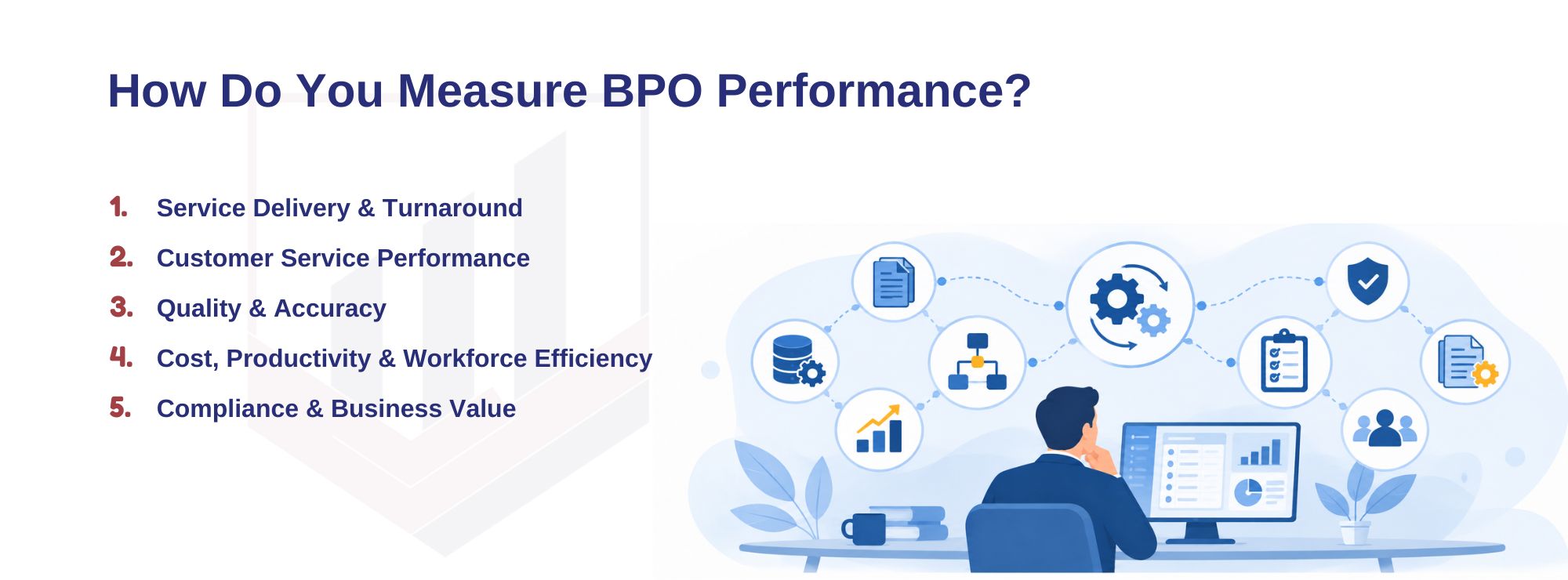
The following KPIs provide a practical framework for evaluating BPO performance.
12 Essential BPO Performance KPIs
1. Service Level Agreement (SLA) Compliance
SLA compliance measures how consistently an outsourcing provider meets the performance commitments established in its service agreement.
These commitments may include response times, processing deadlines, accuracy requirements and system availability.
Why it matters: SLA compliance helps businesses determine whether their outsourcing partners are meeting contractual expectations. Repeated failures may indicate staffing shortages, inefficient processes or inadequate resource planning.
2. First Contact Resolution (FCR)
First Contact Resolution measures the percentage of customer issues resolved during the initial interaction without requiring additional contact.
It is particularly relevant to customer service, technical support and other customer-facing operations.
Why it matters: Higher FCR can reduce repeat enquiries, improve customer satisfaction and lower support costs. It also indicates whether employees have the knowledge and resources needed to resolve customer concerns effectively.
3. Average Handle Time (AHT)
Average Handle Time measures the average time employees spend handling customer interactions, including associated follow-up work.
This metric helps businesses assess the efficiency of their customer support operations.
Why it matters: Monitoring AHT can reveal opportunities to improve workflows, training and resource allocation. However, reducing handling time should not come at the expense of service quality or issue resolution.
4. Quality and Accuracy Rate
Quality and accuracy metrics measure whether outsourced activities are completed correctly and meet established standards.
These metrics are especially important in insurance administration, financial operations, document processing and other back-office services.
Why it matters: Processing errors can create additional administrative work, delay operations and increase costs. Monitoring accuracy helps businesses identify training requirements and opportunities to strengthen quality controls.
5. Customer Satisfaction (CSAT)
Customer Satisfaction measures how satisfied customers are with a particular service or interaction, typically through post-interaction surveys.
It provides a customer-focused perspective on outsourced service delivery.
Why it matters: Meeting operational targets does not necessarily guarantee a positive customer experience. CSAT helps businesses identify service gaps that may not be apparent from efficiency metrics alone.
6. Turnaround Time (TAT)
Turnaround Time measures how long it takes to complete a task or business process from initiation to completion.
It is particularly relevant to back-office activities such as claims documentation, policy administration, invoice processing and reporting.
Why it matters: Excessive turnaround times can delay internal operations and affect customer service. Monitoring TAT helps businesses identify bottlenecks, evaluate processing capacity and improve workflow efficiency.
7. Cost per Transaction
Cost per Transaction measures the average expense associated with completing a specific outsourced activity.
Businesses may track the cost of processing an invoice, handling a customer enquiry or completing an insurance policy update.
Why it matters: This metric helps organizations assess the cost efficiency of outsourcing. However, lower processing costs should be evaluated alongside accuracy and service quality to ensure that savings are not offset by errors or repeated work.
8. Productivity and Utilization Rate
Productivity measures the volume of work completed within a specified period, while utilization indicates how effectively available working capacity is used.
Together, these metrics provide insight into workforce efficiency and operational capacity.
Why it matters: Monitoring productivity and utilization helps businesses evaluate resource allocation and identify capacity constraints. Excessively high utilization may also indicate workloads that could affect service quality and employee performance.
9. Error and Rework Rate
Error Rate measures how frequently mistakes occur, while Rework Rate tracks how often completed activities require corrections or additional processing.
These metrics are particularly useful in documentation-intensive and transaction-based operations.
Why it matters: Repeated errors increase operating costs, consume employee time and delay business processes. Monitoring these metrics helps organizations identify recurring problems and evaluate the effectiveness of corrective measures.
10. Employee Attrition Rate
Employee Attrition Rate measures the proportion of employees leaving an organization during a specified period.
Workforce stability is particularly important in outsourced operations that require specialized knowledge or familiarity with client-specific procedures.
Why it matters: High employee turnover can increase training costs, disrupt service continuity and affect productivity.
11. Compliance and Data Security
Compliance metrics evaluate whether outsourced operations follow applicable regulations, contractual obligations and internal policies.
They may include audit results, policy adherence, security incidents and the timely resolution of compliance issues.
Why it matters: Outsourcing does not eliminate a company's responsibility to manage operational and regulatory risks. Monitoring compliance helps businesses identify weaknesses in procedures, employee training and information security.
12. Return on Investment (ROI)
Return on Investment measures the financial value generated by an outsourcing arrangement relative to its associated costs.
Beyond direct savings, businesses may consider improvements in productivity, operational flexibility and the ability of internal teams to focus on core activities.
Why it matters: ROI connects outsourcing performance with broader business objectives. It helps organizations determine whether an outsourcing arrangement is delivering the expected financial and operational benefits.
Why BPO KPIs Should Be Evaluated Together
Individual KPIs provide useful information, but they rarely present a complete picture of outsourcing performance.
For example, an outsourcing provider may achieve shorter turnaround times while experiencing declining accuracy. Similarly, reducing the cost per transaction may provide limited value if errors and rework create additional expenses.
Businesses should therefore evaluate KPIs together, balancing operational efficiency with service quality, customer experience, compliance and financial performance.
This approach helps organizations identify meaningful improvements rather than pursuing individual targets at the expense of overall results.
How to Set and Monitor BPO Performance Targets
Effective performance measurement begins with establishing clear expectations.
Businesses should first assess their existing operations to establish performance baselines. These provide a reference point for evaluating changes after outsourcing.
Next, they should select KPIs that reflect their operational priorities and establish realistic targets based on service requirements, historical performance and contractual commitments.
Industry benchmarks can provide additional context, but they should not replace targets tailored to specific business processes.
Reporting frequency is equally important. Critical operational metrics may require daily monitoring, while quality, financial performance and broader business outcomes can be reviewed weekly, monthly or quarterly.
Regular performance reviews with outsourcing partners help identify recurring problems, investigate their causes and establish corrective actions.
Conclusion
Effective BPO performance measurement goes beyond tracking a single metric. Businesses need to consider service quality, operational efficiency, customer satisfaction, compliance and financial performance together to understand how well an outsourcing arrangement is working.
Clear KPIs and realistic performance targets also create greater accountability between businesses and their outsourcing partners. Regularly reviewing these metrics makes it easier to identify performance gaps, address emerging issues and determine where processes can be improved.
For organizations evaluating their current outsourcing model or considering a new partnership, these performance expectations should be established from the beginning. An experienced business service provider should be able to align service delivery with clearly defined operational requirements, performance measures and broader business objectives.
Get Consultation
Related Blogs

Recent Blogs
Partner with us today!