 info@triniteconsulting.com
 +1 (224) 385 9760
A new project has been approved. Customer demand is increasing. A specialist has resigned. A system implementation requires expertise the current team does not have.
In each situation, the immediate response may be the same: start hiring.
But the more important question is not simply who should be hired? It is what type of workforce capacity does the business need?
Some requirements justify adding permanent employees who can build long-term knowledge and take ownership of an ongoing function. Others exist only for a project, demand peak, specialist assignment, or temporary operational gap.
Treating every requirement as a permanent vacancy can increase fixed workforce costs and reduce flexibility. Relying too heavily on temporary resources can create challenges around continuity and knowledge retention.
The decision between contract staffing and permanent hiring should therefore begin with the work, its duration, and the business outcome it needs to support.
What Is the Difference Between Contract Staffing and Permanent Hiring?
Contract staffing provides professionals for a defined period, project, workload requirement, or specialist need. Depending on the arrangement, they may be employed through a staffing provider and assigned to support the client organization.
Permanent hiring adds employees without a predetermined end date. It is generally better suited to functions expected to continue and where long-term ownership, organizational knowledge, leadership, or team development matters.
Temporary and alternative work arrangements are an established part of the U.S. labor market. The U.S. Bureau of Labor Statistics reported that 4.3% of employed people were in contingent jobs in July 2023. BLS separately tracks alternative arrangements, including temporary-help-agency workers and workers hired through contract firms.
Neither model is inherently better. The objective is to match the workforce model to the business requirement.
Why Does the Hiring Model Matter?
Hiring decisions affect more than headcount.
A delayed hire can increase workloads, slow project delivery, leave customer demand unsupported, or postpone an initiative. At the same time, adding permanent headcount for a temporary requirement can leave excess capacity once the project or demand period ends.
For an individual company, the important question is not simply how many vacancies exist. It is why they exist and what type of workforce capacity the business needs.
This is why hiring decisions should be considered as part of broader workforce capacity planning, rather than as isolated recruitment decisions.
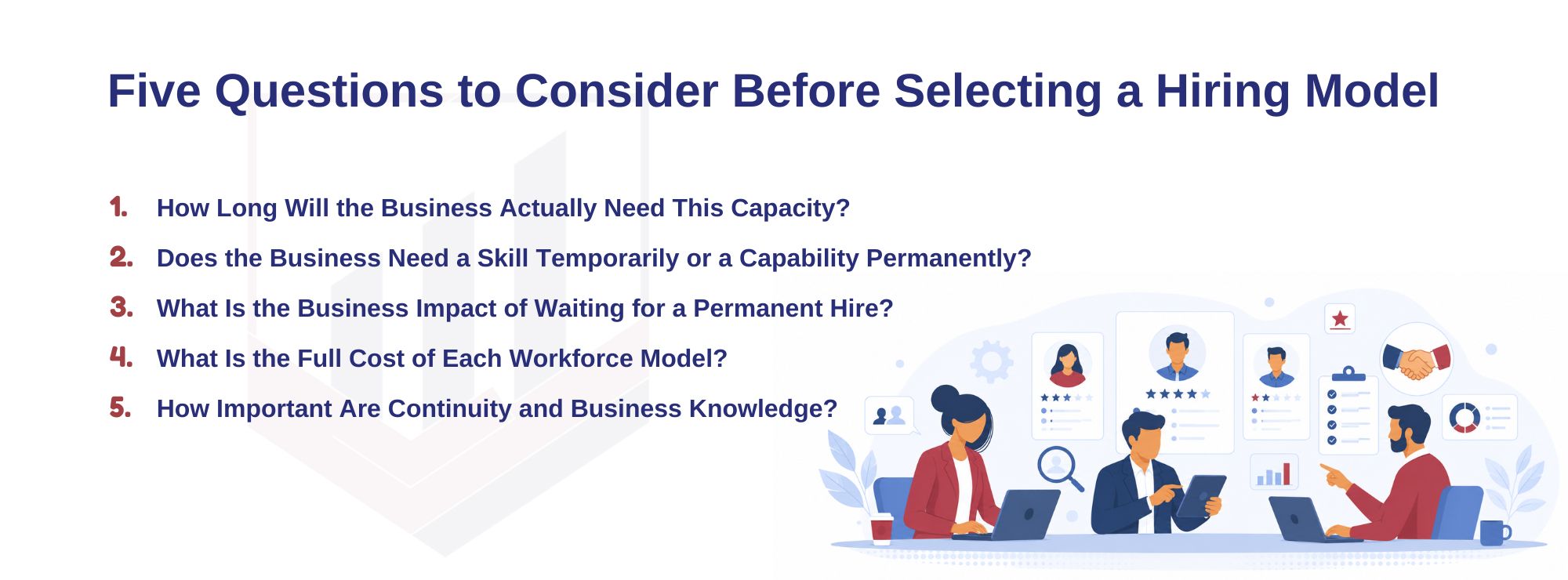
Before selecting a hiring model, management should consider five questions.
1. How Long Will the Business Actually Need This Capacity?
Duration is one of the clearest indicators of whether a requirement is temporary or permanent.
Consider a company implementing a new enterprise system. It may require additional developers, data specialists, project managers, or implementation professionals for several months. Once the implementation is complete, the same level of specialist capacity may no longer be required.
Permanent hiring may make more sense when the work continues after the immediate requirement, such as an ongoing finance, customer-support, compliance, account-management, or technical function.
Management should ask:
- Does the work have a defined completion point?
- Will the same workload remain after the project?
- Is the increase in demand temporary, seasonal, or recurring?
- Will the position support an ongoing business function?
An urgent workload should not automatically become permanent headcount.
2. Does the Business Need a Skill Temporarily or a Capability Permanently?
A skills gap and a permanent role are not always the same problem.
An organization may need a cybersecurity specialist for an assessment, a regulatory professional for a defined compliance initiative, or an experienced developer for an integration. The expertise may be critical without being required at the same level after the work is complete.
Contract staffing can provide specialized skills for the period in which they are needed.
The decision changes when management wants that capability to remain within the organization. Permanent recruitment may be more appropriate when the professional will develop processes, lead future initiatives, train employees, build a team, maintain customer relationships, or make recurring business decisions.
A useful distinction is:
Does the company need someone to complete the work, or does it need to build and retain the capability?
That answer can significantly change the hiring approach.
3. What Is the Business Impact of Waiting for a Permanent Hire?
Not every vacancy carries the same urgency.
Some positions can remain open for several weeks without materially affecting operations. Others begin affecting performance almost immediately.
A resignation may leave customer accounts unsupported. A new contract may require capacity before delivery begins. A delayed technology hire may hold up an implementation involving several departments.
Management should therefore assess:
- Revenue or projects that may be delayed
- Additional workload placed on existing employees
- Overtime or backlog growth
- Customer-service implications
- Deadlines dependent on the role
- Skills unavailable elsewhere internally
Contract staffing can provide an option when qualified capacity is needed quickly, while permanent recruitment continues if the underlying position remains a long-term requirement.
Speed, however, should not replace appropriate screening. Technical ability, experience, communication, security requirements, and suitability still need to be evaluated.
4. What Is the Full Cost of Each Workforce Model?
Comparing a contractor's rate directly with an employee's salary provides an incomplete picture.
Permanent workforce costs can include salary, payroll-related expenses, benefits, paid leave, insurance, recruitment, onboarding, equipment, training, and other employment costs.
For U.S. private-industry workers in March 2026, the Bureau of Labor Statistics reported that wages and salaries accounted for 69.9% of employer compensation costs, while benefits represented 30.1%.[2]
This does not mean every permanent employee costs 30.1% more than salary. The figure represents the overall composition of compensation costs across private industry. Recruitment, equipment, onboarding, and training are separate costs that vary by organization and role.
Contract staffing also has its own cost structure, including staffing-provider charges and, depending on the role, higher hourly or project rates for specialized talent.
The more useful comparison is not:
Which worker has the lower hourly cost?
It is:
What will each model cost over the period for which the capacity is actually required?
Permanent employees can provide greater long-term value where work is stable and recurring. Contract staffing may be more practical when the requirement is temporary and additional capacity will no longer be needed after the work ends.
5. How Important Are Continuity and Business Knowledge?
Some roles become more valuable as employees develop knowledge of customers, systems, internal processes, and organizational priorities.
Permanent hiring is often better suited to positions involving:
- Leadership
- Long-term customer relationships
- Process ownership
- Strategic decision-making
- Team development
- Organization-specific knowledge
Contract professionals can also perform knowledge-intensive work, but assignments should be designed with continuity in mind.
For major implementations or specialist projects, documentation and knowledge transfer should be built into the assignment rather than addressed only when the contract is ending.
This helps ensure that systems, processes, and technical knowledge remain accessible to internal teams after the assignment.
Where Does Contract-to-Hire Fit?
Sometimes the immediate requirement is clear while the long-term requirement is not.
A company may need additional capacity today but be uncertain whether demand will continue. It may be launching a new function, entering a market, expanding a customer account, or testing a new operating model.
Contract-to-hire provides an intermediate option.
The professional begins on a contract basis with the possibility of moving into permanent employment. During that period, the organization can evaluate work quality, technical ability, communication, collaboration, and whether the underlying role is becoming permanent.
The professional can also evaluate the role, team, responsibilities, and working environment.
The arrangement should have clear terms covering the contract period, conversion process, expectations, and applicable staffing-provider conditions. It should be treated as a planned workforce option rather than an indefinite trial period.
Can a Business Use Contract and Permanent Staffing Together?
For many organizations, the choice does not need to be one model or the other.
A blended workforce can allow permanent employees to retain core business knowledge while contract professionals provide additional capacity or specialist expertise when needed.
An insurance company may maintain permanent claims leadership while adding contract professionals during higher claims volumes. A technology company may retain permanent product teams while using specialist resources for a system migration. A pharmaceutical business may use contract professionals for a time-bound regulatory initiative while maintaining permanent quality and compliance functions.
The objective is not to maximize either permanent or contract headcount. It is to create a workforce structure that reflects how the business operates.
A Practical Decision Framework
| Business Requirement | Model to Consider |
|---|---|
| Defined project or completion date | Contract staffing |
| Temporary or seasonal workload increase | Contract staffing |
| Urgent specialist requirement | Contract staffing |
| Temporary employee absence | Contract staffing |
| Stable, ongoing business function | Permanent hiring |
| Long-term leadership or process ownership | Permanent hiring |
| Capability needs to remain within the company | Permanent hiring |
| Immediate need but uncertain future demand | Contract-to-hire |
| Potential permanent role still developing | Contract-to-hire |
These indicators provide direction rather than a fixed rule.
The final decision should also consider workforce cost, skill availability, urgency, business risk, internal management capacity, and applicable employment requirements.
When working with a staffing provider, responsibilities around payroll, onboarding, supervision, data access, assignment expectations, and employment administration should also be clearly established.
Choose the Workforce Model That Matches the Work
The decision between contract staffing and permanent hiring is ultimately a workforce-planning decision.
Contract staffing can help businesses respond to temporary demand, specialist assignments, urgent capacity requirements, and projects with defined timelines.
Permanent hiring is generally better suited to continuing functions where long-term ownership, organizational knowledge, leadership, and capability development matter.
Contract-to-hire can bridge the two when an immediate requirement exists but its long-term future is still developing.
For some businesses, the strongest workforce structure may include all three.
Before opening another permanent vacancy or adding another contractor, management should return to the underlying question:
What work needs to be delivered, for how long, and what workforce structure gives the business the capacity to deliver it effectively?
Trinite Consulting supports businesses through contingent staffing, permanent staffing, and contract-to-hire solutions, helping organizations align talent requirements with the nature, duration, and priorities of the work.
Get Consultation
Related Blogs
Recent Blogs
Partner with us today!


