 info@triniteconsulting.com
 +1 (224) 385 9760
Technology should make a business easier to run. Yet as organizations add CRM platforms, ERP systems, finance applications, customer-service tools and specialized software, their technology environment can become more complex rather than more efficient.
According to MuleSoft’s 2026 Connectivity Benchmark, the average organization manages 957 applications, while only 27% are connected.
The challenge is not to connect every system. It is to determine what should be retained, integrated, consolidated or retired—and ensure the technology that remains supports the business effectively.
For many organizations, disconnected technology creates an ongoing operating tax: additional employee effort, repeated data handling, slower decisions, more maintenance and unnecessary complexity that builds over time.
When Business Systems Stop Working Together
Technology fragmentation rarely happens intentionally.
Sales adopts a CRM. Finance introduces another platform. Operations adds workflow software. Customer service purchases a specialized application. Employees create spreadsheets to transfer information between them.
Individually, each decision may make sense. Problems begin when those systems cannot exchange information reliably.
Common warning signs include:
- Employees entering the same information into multiple systems.
- Teams relying on spreadsheets or CSV files to transfer data.
- Departments reporting different numbers for the same metric.
- Customers repeating information across departments.
- Several applications performing similar functions.
- Employees switching repeatedly between systems to complete one task.
- System changes unexpectedly disrupting other workflows.
Research published by Harvard Business Review found that employees in its study switched between applications and websites around 1,200 times per day, with the effort required to regain focus consuming close to four hours each week.
The problem is not simply having many applications. The problem appears when employees become the integration layer.
If people must continuously copy, export, upload, reconcile and verify information just to move a process forward, technology is creating additional work instead of removing it.
Why Technology Environments Become Fragmented
One major cause is department-level technology purchasing. Different teams choose applications based on immediate needs, often without considering how those systems will interact with the wider business.
Temporary workarounds can also become permanent. A spreadsheet or manual export introduced as a short-term solution may still be supporting an important workflow years later.
Legacy systems create another challenge. They may remain essential to the business while lacking modern integration capabilities, forcing organizations to build additional tools and interfaces around them.
Growth and acquisitions can add further complexity. Acquired businesses may bring separate CRM, finance, HR and operational platforms. Without a rationalization plan, duplicate systems can remain in place long after the businesses have been combined.
Shadow IT adds another layer. Departments can adopt cloud tools quickly outside formal IT processes, creating additional data stores and integration requirements.
Over time, these workarounds contribute to technical debt. McKinsey has found that organizations can spend an additional 10% to 20% on technology projects addressing technical debt.
Adding another application does not necessarily solve fragmentation. Sometimes it simply adds another layer of complexity.
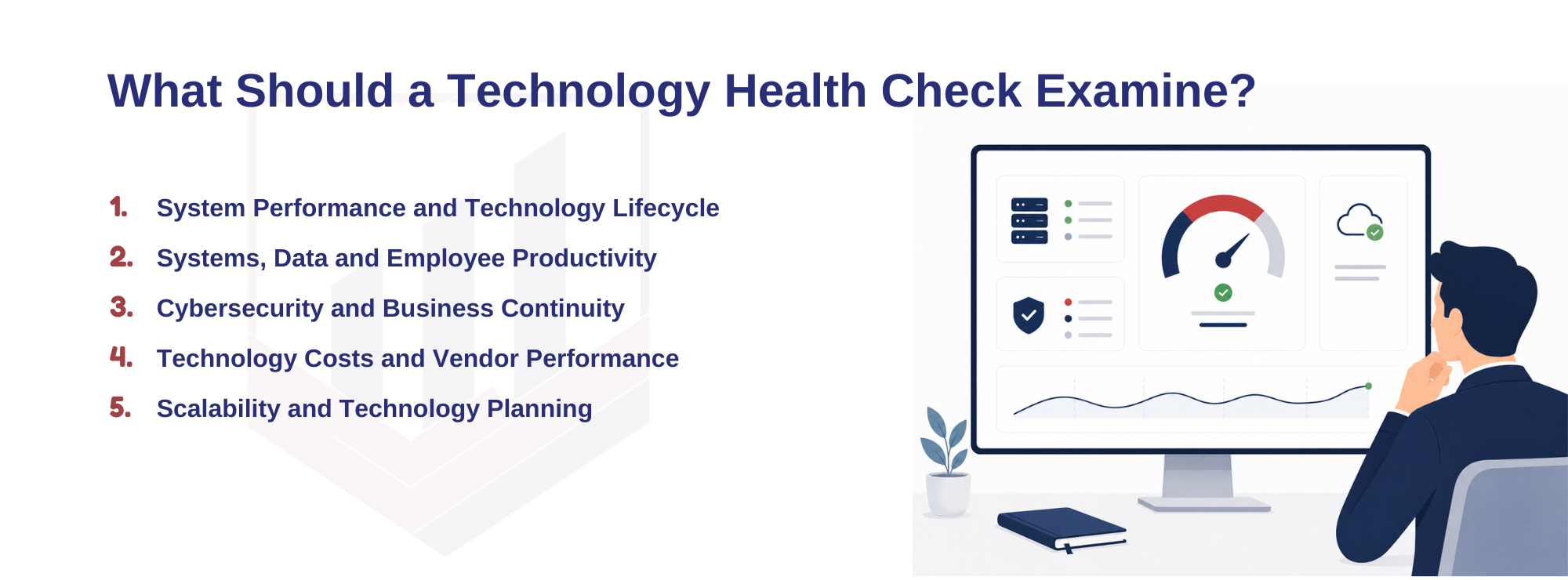
Before investing in additional systems, businesses may benefit from conducting a technology health check to identify outdated systems, failed integrations, overlapping applications and recurring workflow issues.
The Hidden Business Cost
The visible cost of technology is usually the software subscription or licensing fee. The larger cost may be the operational effort surrounding it.
Consider an order that moves through sales, ERP, warehouse, invoicing and customer service.
If those systems do not communicate properly, employees may need to download files, re-enter information, reconcile records, investigate discrepancies and correct mistakes.
The result can include:
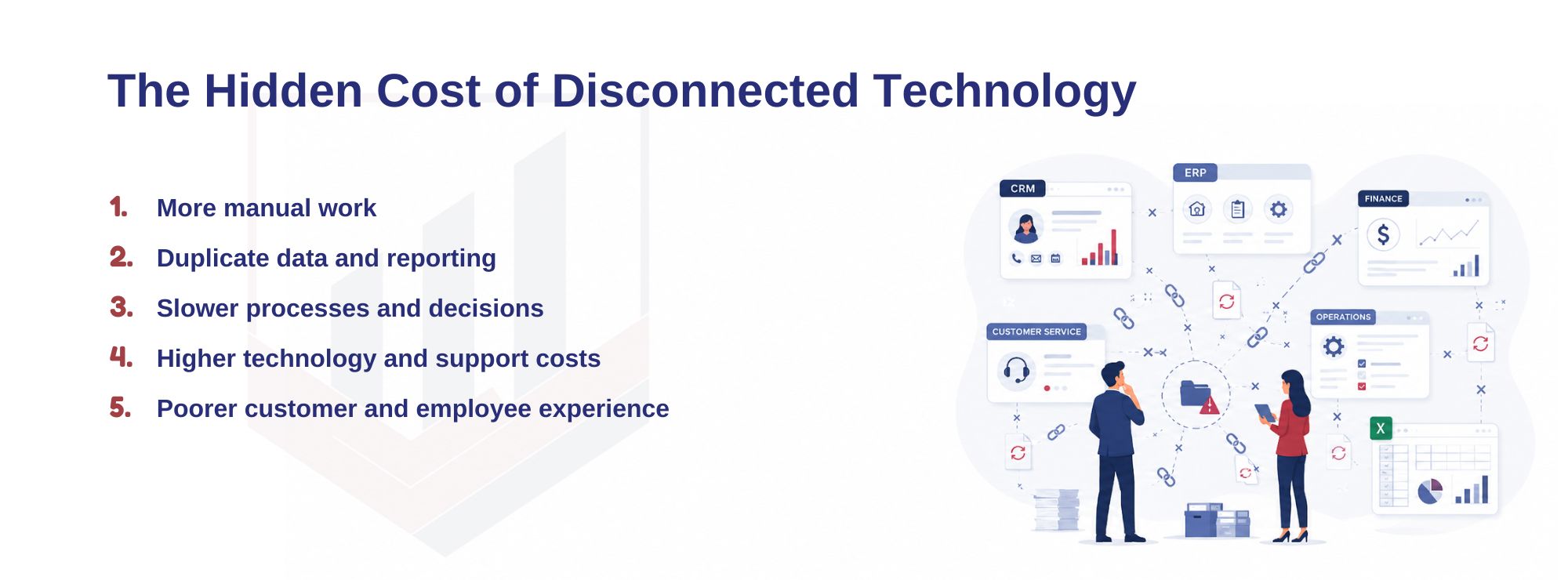
- More manual work.
- Higher risk of errors.
- Slower approvals and processing.
- Additional support requirements.
- Increased maintenance costs.
- Poorer customer experiences.
- Slower management reporting.
These costs often do not appear clearly in the technology budget, but they still affect productivity and operating margins.
The key question is not only:
“How much are we spending on software?”
It is also:
“How much work is required because our systems do not work together effectively?”
Data Quality Becomes a Business Problem
Disconnected systems can create multiple versions of the same information.
Which system contains the correct customer address? Which inventory figure should operations use? Should leadership trust CRM or finance when reviewing revenue?
Gartner estimates that poor data quality costs organizations at least $12.9 million per year on average, although the actual impact varies considerably between businesses. [4]
The issue is not simply inaccurate reporting. When leaders do not trust business information, meetings can shift from deciding what action to take to debating which number is correct.
Integration alone will not solve this problem.
Connecting two systems can move information faster, but businesses still need to determine which system is authoritative and who is responsible for maintaining the quality of critical data.
Fragmentation Can Increase Risk
As systems multiply, the number of dependencies that must be managed increases. Applications may have different access rules, security configurations and data-retention requirements, while changes in one system may unexpectedly affect another.
Simplification can therefore reduce both operational effort and the number of systems, interfaces and access points teams need to govern.
Start With the Business Process, Not the Technology
When systems are disconnected, the first question should not be:
“Which integration platform should we buy?”
A better question is:
“Which business process are we trying to improve?”
For example, if customer information entered by sales does not reach billing correctly, the objective is not simply to connect the CRM and finance platforms.
The objective is to create a reliable information flow from the initial customer interaction through billing, service and reporting.
The same approach can be applied to other critical journeys:
Lead → opportunity → contract → onboarding
Order → fulfillment → invoicing → payment
Employee recruitment → onboarding → payroll
Customer issue → service request → resolution
Mapping these journeys reveals where information stops moving, where employees intervene manually and where unnecessary applications exist.
Integration Is Not Always the Answer
When fragmentation is discovered, organizations often move immediately toward integration. Sometimes that is the right solution, but it should not be the automatic response.
If two applications perform nearly the same function, maintaining both and integrating them may create more complexity than consolidating onto one platform.
A practical classification is:
Keep — The application remains valuable and requires no significant change.
Connect — The application should remain, but information needs to move more reliably.
Consolidate — Multiple overlapping applications can be reduced to fewer platforms.
Replace — The system no longer supports important business requirements.
Retire — The application provides insufficient value to justify its cost and complexity.
This helps prevent every technology problem from becoming an integration project.
A Practical Approach to Simplifying Technology
Businesses can begin with four steps.
1. Understand the Current Environment
Create an inventory of major applications, their purpose, cost, owner, users and integrations. Include critical spreadsheets and departmental tools, not just enterprise systems.
Then map the systems supporting important processes.
Customer order → CRM → ERP → warehouse → invoicing → customer service
This can quickly reveal manual handoffs, duplicated data and unnecessary applications.
2. Simplify Before Integrating
Look for unused licenses, overlapping applications, unnecessary exports and outdated systems.
Not every system needs to be connected. In some cases, consolidating or retiring an application may be more effective.
3. Establish Data Ownership
Critical customer, supplier, employee, product and financial information should have clearly defined owners and authoritative systems.
Without this, businesses risk integrating inconsistent data across more applications.
4. Prioritize by Business Impact
Focus first on problems creating the greatest employee effort, operating cost, customer friction or business risk.
A high-volume process involving frequent manual transfers may deserve attention before an outdated system that creates little operational disruption.
Useful measures can include process cycle time, manual handoffs, data correction rates, support incidents, integration failures and the time required to produce reports.
How Trinite’s Technology Services Can Help
Resolving disconnected technology is not only an integration exercise. It requires businesses to look at systems, workflows, information flows and operational requirements together.
Trinite’s technology services support organizations in improving how technology works across the business—from identifying inefficient or fragmented processes to developing and improving the systems that support them.
This can include support across areas such as:
- Application and system development to address specific business requirements.
- System integration to improve information flow between platforms.
- Process automation to reduce repetitive manual work and handoffs.
- Data and analytics solutions to improve visibility and reporting.
- Technology support and optimization to maintain and improve business systems over time.
The objective is not to introduce technology for its own sake. It is to create systems and workflows that improve operational efficiency, provide better access to information and support changing business requirements.
For organizations already managing multiple platforms, this may mean improving existing systems rather than replacing everything at once.
Simplify First. Then Connect What Matters.
A fragmented technology environment does not automatically require another standalone tool.
Businesses should first understand what they already have, remove unnecessary duplication, establish clear ownership and identify the system connections that have the greatest impact on employees, customers and operations.
The goal is not to connect everything.
It is to build a technology environment in which information moves reliably, systems have clearly defined roles and employees do not need to compensate for gaps between applications.
That creates a stronger foundation for automation, analytics, AI and future growth without continuously adding complexity.
Get Consultation
Related Blogs
Recent Blogs
Partner with us today!


