info@triniteconsulting.com
 +1 (224) 385 9760
- Start With Clear Business Requirements
- Evaluate Technical Expertise and Industry Experience
- Assess Security and Third-Party Risk
- Examine Service Levels, Governance, and Communication
- Compare Total Value, Not Just Hourly Rates
- Review Contract Terms and Plan for Exit
- Red Flags When Choosing a Technology Partner
- Technology Partner Evaluation Checklist
- Choosing a Partner for Long-Term Business Value
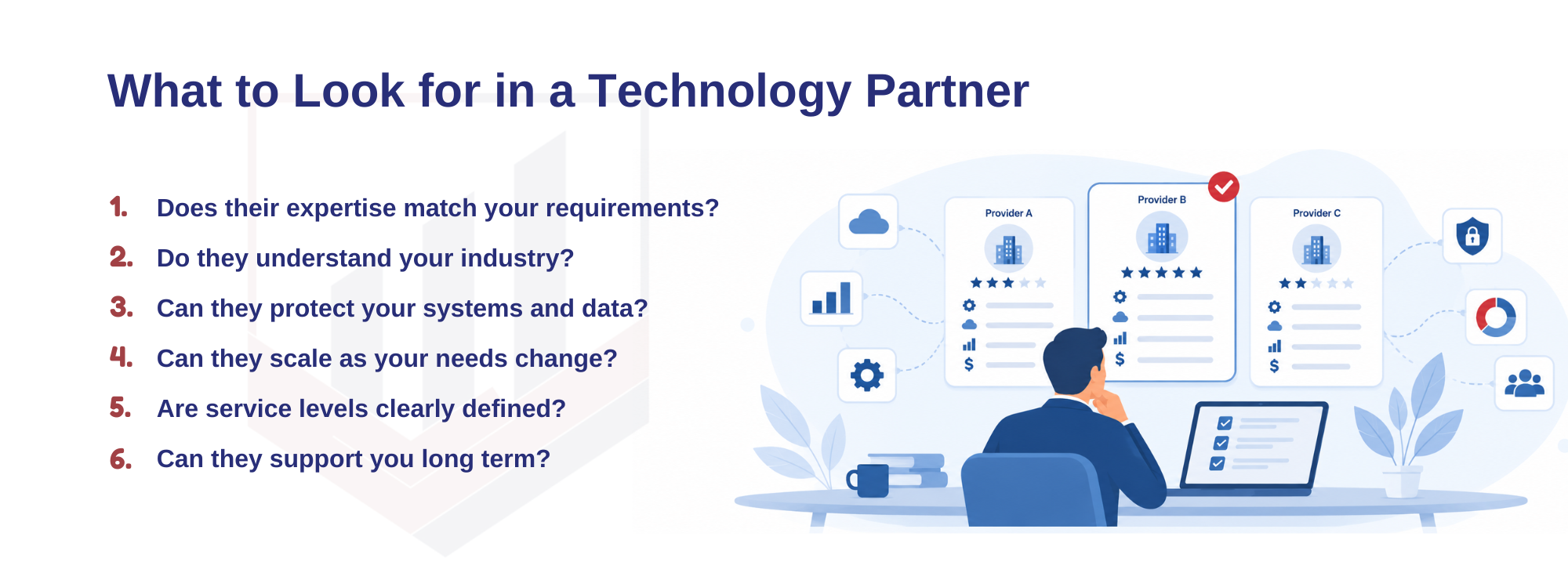
Choosing the right technology partner requires more than comparing technical capabilities or hourly rates. Businesses should evaluate potential providers based on their technical expertise, industry experience, security practices, scalability, service levels, communication, commercial model, and ability to support changing technology requirements.
The right partner can provide specialized expertise and additional capacity without requiring a business to build every technology capability internally. Depending on the organization, these technology and IT services can include software development, application support, cloud services, infrastructure management, data solutions, quality assurance, automation, AI, and other specialized capabilities.
A structured evaluation process can help businesses identify a technology partner that meets immediate requirements while also supporting long-term business objectives.
Start With Clear Business Requirements
Before comparing technology services providers, clearly define what you need the partnership to accomplish.
Consider your immediate priorities. Do you need to modernize legacy applications, improve technology support, strengthen cybersecurity, move workloads to the cloud, develop new applications, introduce AI and automation, or access specialized expertise without expanding your permanent internal team?
Once the requirements are clear, define the scope, priorities, and expected outcomes. A Business Requirements Document (BRD) can help document functional requirements along with performance, security, legal, support, and training considerations.
Set measurable objectives as well. These might include reducing application downtime, improving response times, shortening development cycles, lowering support costs, or increasing the capacity of your internal technology team.
Clear requirements and measurable objectives provide a stronger basis for evaluating and comparing potential technology services partners.
Evaluate Technical Expertise and Industry Experience
Technical capability should be evaluated in the context of your technology environment and business requirements.
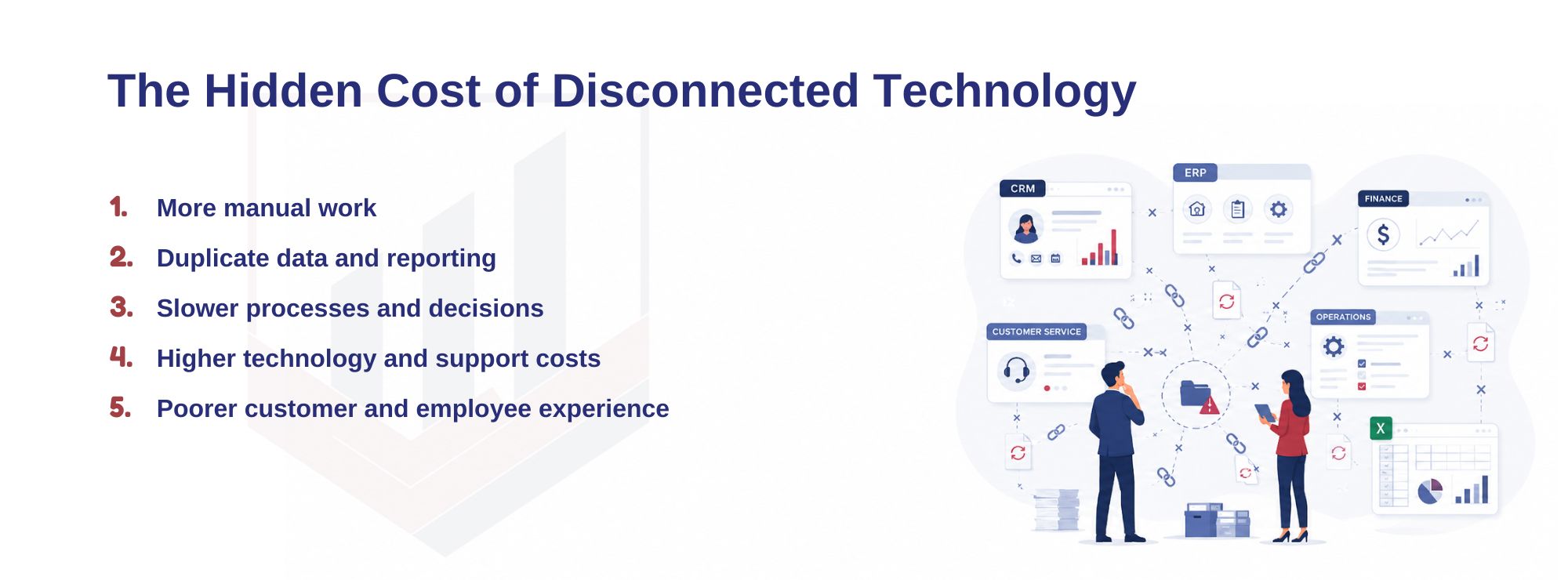
When evaluating a technology or IT services provider, review its experience with relevant areas such as application development, cloud platforms, APIs and integrations, databases, infrastructure, cybersecurity, data analytics, automation, artificial intelligence, DevOps, testing, and production support. If your business relies on multiple applications and platforms, the provider’s ability to integrate disconnected systems and improve the flow of data between them may also be important.
But don’t rely only on a company’s website or technology list. Ask who will actually work on your account, what experience those professionals have, how technical quality is reviewed, and whether the provider has successfully delivered similar projects.
Industry experience is also important. A company familiar with your sector will better understand its workflows, technology requirements, and regulatory considerations. For example, insurance organizations may require expertise in policy administration and claims processes, while pharmaceutical companies may have specific requirements around applications, data, quality processes, and compliance.
Ask potential partners for relevant case studies and client references to validate their industry experience and delivery capabilities.
Assess Security and Third-Party Risk
A technology partner may gain access to applications, infrastructure, credentials, systems, or sensitive business data. Security therefore needs to be evaluated before the relationship begins.
Review the provider’s access controls, authentication practices, encryption, vulnerability management, incident-response procedures, employee security training, data-handling policies, and business continuity processes.
Depending on your industry and the nature of the engagement, you may also need to evaluate certifications, standards, regulatory requirements or other applicable frameworks.
Cybersecurity should also be considered from a supply-chain and third-party risk perspective. Businesses should perform appropriate due diligence before entering supplier relationships and establish cybersecurity requirements for suppliers and other third parties. Your contract should clearly define responsibilities for confidentiality, data protection, cybersecurity incidents, notification procedures, and access to business information.
A capable technology or IT services partner should be able to explain how your information and systems will be protected rather than relying on general claims about security.
Consider Scalability and the Engagement Model
Technology requirements rarely remain static.
You may initially need a few specialists for an application project and later require application maintenance, data analytics, cloud support, automation, cybersecurity, or round-the-clock production support.
Evaluate whether the provider can expand or adjust both its resources and capabilities as your requirements change. You should also determine which engagement model best suits the work.
Staff augmentation adds external specialists to your existing team while your organization retains responsibility for priorities and day-to-day management. Project-based services are generally suited to clearly defined initiatives with established deliverables, scope, and timelines.
Managed services transfer responsibility for an ongoing technology function to the provider, usually with agreed service levels and performance measures. Some organizations may also consider outcome-based models, where elements of the commercial arrangement are connected to agreed results. The best model depends on your internal technology leadership, management capacity, scope, risk tolerance, and desired level of control.
Examine Service Levels, Governance, and Communication
Strong technical capabilities will have limited value if the provider is difficult to work with when priorities change or problems occur. Service Level Agreements (SLAs) should establish measurable expectations around areas such as availability, support coverage, response times, resolution targets, escalation procedures, and reporting.
For business-critical systems, determine whether support is available outside standard working hours and how high-priority incidents will be escalated. Communication should also be evaluated during the selection process.
Does the provider ask questions about your business before recommending solutions? Are technical explanations clear? Are risks and limitations discussed openly? How quickly does the team respond?
Before onboarding, establish how the relationship will operate. Define meeting frequency, reporting, project management tools, documentation requirements, responsibilities, escalation paths, and key contacts on both sides.
A strong technology partner should function as an extension of your organization rather than an isolated vendor that appears only when a deliverable is due.
Compare Total Value, Not Just Hourly Rates
Cost matters, but the lowest hourly rate does not necessarily produce the lowest overall technology cost. Poor software quality, recurring outages, weak documentation, security issues, delays, rework, and high employee turnover can quickly offset the savings offered by a lower-priced provider.
Evaluate the total cost and expected value of the engagement instead.
When comparing technology partners, consider implementation costs, ongoing support, licensing, infrastructure, internal management requirements, transition costs, and potential switching costs. Also consider whether the provider can improve productivity, increase technology capacity, reduce downtime, or help your internal team focus on higher-value priorities.
This provides a more meaningful basis for comparing technology partners than hourly rates alone.
Review Contract Terms and Plan for Exit
A technology services agreement should explain not only how the relationship starts but also what happens if it ends.
Clearly define ownership of source code, documentation, configurations, intellectual property, credentials, and business data.
If a provider uses proprietary platforms, frameworks, or tools, understand whether your organization will remain dependent on them after the engagement.
Contracts should also address confidentiality, data protection, SLAs, pricing, scope changes, responsibilities, termination rights, and knowledge transfer. Most importantly, establish an exit process.
Your organization should be able to recover its data, documentation, credentials, source code, and other required materials and transfer the work to another provider or internal team.
Planning for transition from the beginning can reduce the risk of vendor lock-in.
Red Flags When Choosing a Technology Partner
Some warning signs should prompt additional due diligence.
Be cautious when a provider cannot clearly identify who will work on your account, provides vague answers about security, offers unclear pricing, avoids measurable service commitments, cannot provide relevant references, or promises solutions before understanding your business and technology environment.
Other concerns include poor documentation practices, excessive dependence on proprietary technology, unclear ownership of intellectual property, unusually restrictive termination terms, and no defined process for transferring knowledge or data at the end of the engagement.
A good partner should be comfortable discussing limitations and risks as well as capabilities.
Technology Partner Evaluation Checklist
Using the same criteria for every shortlisted provider can make comparisons more consistent and help decision-makers focus on the areas that matter most. Evaluation Area What to Evaluate
| Evaluation Area | What to Evaluate |
| Technical expertise | Relevant technologies, platforms, skills, and project experience |
| Industry experience | Understanding of your industry, workflows, and requirements |
| Security and compliance | Controls, certifications, data protection, and incident response |
| Scalability | Ability to expand or adjust resources and capabilities |
| Service levels | Support coverage, response times, resolution targets, and escalation |
| Communication | Responsiveness, reporting, transparency, and governance |
| Commercial model | Pricing structure, total cost, and flexibility |
| References | Relevant case studies and client feedback |
| Contract terms | IP ownership, confidentiality, data rights, and responsibilities |
| Exit strategy | Documentation, data portability, and knowledge transfer |
For larger engagements, turn this checklist into a weighted scorecard. Give greater weight to criteria that carry the greatest business risk. Security and availability, for example, may carry more weight for a business-critical application than for a short-term development project.
Using consistent criteria also reduces the risk of selecting a provider simply because it delivered the most impressive sales presentation.
Choosing a Partner for Long-Term Business Value
Selecting a technology partner is ultimately a business decision, not simply an IT procurement exercise.
The right provider should bring together the technical expertise, industry understanding, security practices, delivery model, and scalability your organization needs. Just as importantly, the relationship should be flexible enough to evolve as your technology and business priorities change.
This is the approach Trinite Consulting brings to its Technology Services engagements. By combining technology expertise with an understanding of business and operational requirements, Trinite helps organizations access the capabilities and additional capacity they need without having to build every technology function internally.
Whether the requirement involves application development, cloud and infrastructure support, data solutions, automation, AI, quality assurance, or ongoing technology support, the goal is the same: to provide the right expertise and delivery model for the organization’s requirements.
A successful technology partnership should solve today’s requirements while giving the business the flexibility to respond to what comes next.
Get Consultation
Related Blogs
Recent Blogs
Partner with us today!