info@triniteconsulting.com
 +1 (224) 385 9760

Every business strives to improve operational efficiency, reduce costs, and enhance customer experiences. Organizations often achieve these goals through incremental improvements, such as simplifying approvals, automating repetitive tasks, or refining workflows.
However, these adjustments may not always address the underlying causes of poor performance.
Consider a company experiencing persistent delays in customer order processing. Despite introducing new software, training employees, and modifying approval procedures, processing times remain high.
The problem may not be how individual tasks are performed, but how the entire process is structured.
This is where Business Process Re-Engineering (BPR) becomes essential. Instead of making small adjustments, BPR fundamentally redesigns business processes to achieve significant improvements in efficiency, cost, quality, and customer satisfaction. A structured business process consulting approach can help organizations identify when such fundamental changes are necessary and how to implement them effectively.
What Is Business Process Re-Engineering?
Business Process Re-Engineering is a strategic approach to analyzing and fundamentally redesigning business processes to improve organizational performance.
Unlike traditional process optimization, which refines existing procedures, BPR questions whether those procedures are necessary.
For example, a company may have separate teams responsible for receiving orders, verifying information, obtaining approvals, and updating records.
Traditional optimization might reduce the time spent on each activity. BPR examines whether these activities can be combined, automated, or eliminated.
The objective is not simply to make an existing process faster, but to create a more effective workflow aligned with current business needs.
Business Process Re-Engineering vs. Continuous Improvement
Continuous improvement and BPR both aim to improve business performance, but their approaches differ.
Continuous improvement focuses on gradual changes to existing processes. Methodologies such as Lean, Six Sigma, and Kaizen help eliminate waste, reduce errors, and improve consistency.
These approaches work well when the underlying process is effective but requires refinement.
Business Process Re-Engineering, however, involves substantial changes to workflows, responsibilities, systems, or operating models.
For instance, a financial services company might use continuous improvement to reduce documentation errors in loan processing.
A BPR initiative could redesign the entire approval process using integrated digital workflows, automated verification, and coordinated decision-making.
Both approaches are valuable. The challenge is recognizing when incremental improvements are sufficient and when fundamental transformation is required.
While traditional process optimization focuses on improving existing workflows, BPR involves fundamentally rethinking and redesigning how business processes operate.
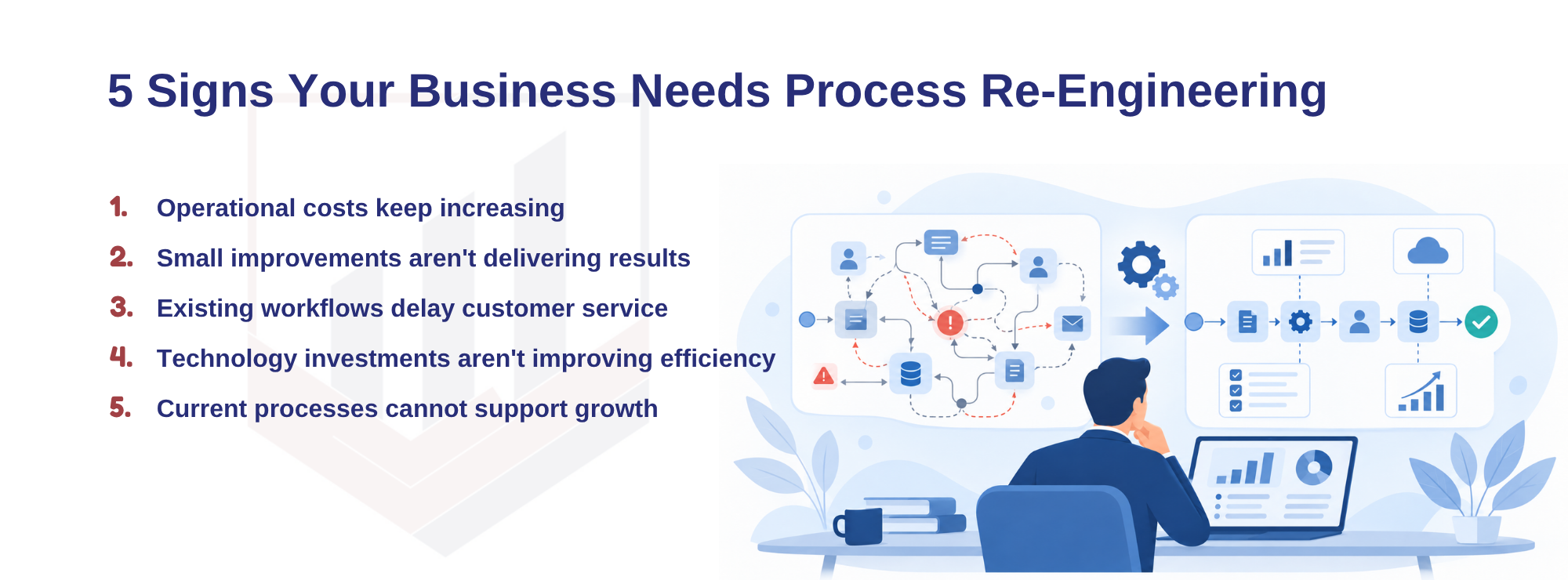
Signs Your Business Needs Process Re-Engineering
Certain recurring operational challenges may indicate that existing processes can no longer support business objectives.
1. Operational Costs Continue to Increase
Rising costs are often associated with unnecessary approvals, duplicated activities, manual data entry, and fragmented systems.
Small improvements may reduce individual expenses without addressing the structural inefficiencies behind them.
BPR examines the complete workflow to identify activities that can be simplified, consolidated, or eliminated.
2. Process Improvements Deliver Limited Results
Organizations frequently optimize individual departments without achieving meaningful improvements in overall performance.
For example, a customer service team may respond quickly to complaints, but resolution still takes several days because requests move between departments.
Improving isolated activities cannot always overcome inefficiencies across the broader process.
BPR addresses this by evaluating workflows from beginning to end.
3. Customer Expectations Have Outgrown Existing Processes
Customers expect faster responses, transparent communication, and convenient digital experiences.
Businesses relying on outdated approvals, manual documentation, and disconnected systems may struggle to meet these expectations.
When existing workflows consistently prevent effective service delivery, fundamental redesign may be necessary.
4. Technology Investments Are Not Delivering Results
Organizations invest in software, automation, and artificial intelligence to improve efficiency.
However, technology cannot independently resolve poorly designed processes.
Automating a workflow containing unnecessary steps may simply make those steps happen faster.
BPR helps simplify processes before technology implementation, ensuring digital investments deliver meaningful operational value.
5. Existing Processes Cannot Support Growth
Workflows that function effectively in smaller organizations may become inefficient as business volumes and operational complexity increase.
Manual coordination, informal approvals, and disconnected systems can create bottlenecks during expansion.
BPR helps develop scalable processes that support growth without proportionately increasing administrative effort.
Key Steps in Successful Business Process Re-Engineering
Successful BPR requires a structured approach that connects process redesign with organizational strategy.
Step 1: Identify Processes Requiring Fundamental Change
Not every process needs redesigning.
Organizations should prioritize workflows that significantly affect operational costs, customer satisfaction, revenue, or service quality.
Common examples include order-to-cash, procure-to-pay, customer onboarding, claims processing, and recruitment.
Processes where performance consistently falls short despite incremental improvements are strong candidates for BPR.
Step 2: Map and Analyze Existing Workflows
Before redesigning a process, organizations must understand how it currently operates.
Process mapping identifies activities, responsibilities, dependencies, approval stages, and information flows.
This analysis often reveals unnecessary verification steps, duplicated data entry, and delays between departments.
Understanding the complete workflow helps distinguish essential activities from those creating avoidable costs and inefficiencies.
Step 3: Redesign Processes Around Business Outcomes
The central principle of BPR is challenging existing assumptions.
Instead of asking how an activity can be performed faster, organizations should question whether it is required.
Important considerations include:
- Can unnecessary approvals be eliminated?
- Can responsibilities be consolidated?
- Can information be captured once and shared across systems?
- Can repetitive activities be automated?
- Can customers complete certain tasks independently?
Redesigned processes should prioritize efficiency, customer value, accountability, and scalability.
Step 4: Integrate Technology Strategically
Technology enables redesigned workflows through automation, integrated enterprise systems, artificial intelligence, and data analytics.
For example, an insurance company could improve claims processing through digital submissions, automated document validation, and centralized case management.
However, technology selection should follow process redesign.
The objective is to support efficient workflows, not automate unnecessary procedures.
Step 5: Implement Change and Measure Performance
BPR frequently changes responsibilities, reporting structures, and established working practices.
Effective change management is therefore essential.
Organizations should communicate transformation objectives, involve employees, provide training, and implement changes systematically.
Performance should be monitored using Key Performance Indicators (KPIs), including:
- Process cycle time
- Cost per transaction
- Error and rework rates
- Customer satisfaction
- Employee productivity
These metrics help determine whether redesigned processes deliver measurable improvements.
Business Process Re-Engineering Across Industries
BPR applies across industries where complex workflows involve multiple departments.
Insurance: Insurers can redesign claims processing by integrating submissions, verification, assessment, and settlement activities to reduce delays and improve transparency.
Financial Services: Banks can re-engineer customer onboarding and loan approvals to simplify documentation, streamline decision-making, and improve service delivery.
Manufacturing: Manufacturers can redesign procurement, inventory management, and production planning to reduce coordination gaps and improve resource utilization.
Healthcare: Healthcare organizations can improve patient registration, appointment scheduling, and administrative coordination by eliminating unnecessary handoffs.
Across these sectors, BPR helps address structural inefficiencies and improve operational performance.
Common Challenges in Business Process Re-Engineering
Although BPR offers significant opportunities, fundamental transformation introduces challenges.
Employee resistance is a common concern. Changes to established workflows and responsibilities may create uncertainty, particularly when employees do not understand the objectives.
Insufficient leadership alignment can also affect implementation. Since BPR often involves multiple departments, executive sponsorship and clear accountability are essential.
Organizations may also underestimate implementation complexity. Redesigning processes requires coordinated changes to systems, procedures, and employee capabilities.
Another risk is focusing exclusively on cost reduction while overlooking customer experience, service quality, or regulatory requirements.
Successful BPR requires a balanced approach that considers operational feasibility, employee engagement, and long-term business goals.
How Business Process Consulting Supports Process Re-Engineering
Business Process Re-Engineering becomes particularly challenging when inefficiencies extend across departments, systems, and established workflows.
Business process consulting helps organizations identify operational bottlenecks, evaluate existing processes, and develop practical solutions that improve efficiency and performance.
Through process assessment, root cause analysis, workflow redesign, and technology integration, businesses can eliminate unnecessary activities and establish more streamlined operations.
A structured approach also supports implementation planning, performance measurement, and change management, ensuring redesigned processes deliver sustainable results.
Final Thoughts
Continuous improvement remains important for maintaining efficient operations. However, making existing processes slightly faster or less expensive is not always enough.
When rising costs, recurring bottlenecks, outdated workflows, and changing customer expectations limit business performance, organizations must reconsider how work is structured.
Business Process Re-Engineering enables companies to move beyond temporary fixes and develop efficient, scalable, and customer-focused operating models.
With strategic planning, process analysis, technology integration, and effective change management, businesses can transform operational challenges into opportunities for long-term growth.
At Trinite Consulting, we help organizations identify operational inefficiencies, optimize business processes, and develop strategies that support sustainable performance improvement.
Get Consultation
Related Blogs
Recent Blogs
Partner with us today!